




What's Happening?
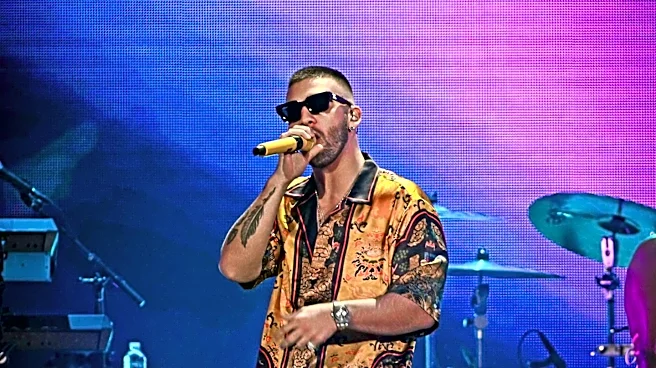
During her visit to Mexico for the Beliween event, actress Victoria Justice mistakenly identified Bad Bunny as her favorite Mexican singer. When questioned by reporters at the Mexico City airport about Mexican artists she knew, Justice initially mentioned
Bad Bunny, who is Puerto Rican, and then Jennifer Lopez, who is also of Puerto Rican descent. This occurred despite her expressing enthusiasm for Mexican music and her Mexican fans. The actress also admitted to not being familiar with the music of Luis Miguel, a renowned Mexican singer. Later in her visit, Justice did express admiration for mariachi music and praised Belinda, the host of the Beliween event, calling her 'wonderful.' The incident quickly gained traction on social media, highlighting a common perception among some in the English-speaking entertainment industry that views 'Latin' culture as a monolithic entity without distinct national identities.
Why It's Important?
This incident underscores a broader issue within the entertainment industry regarding the understanding and representation of diverse Latin American cultures. While seemingly a minor gaffe, it reflects a tendency to generalize 'Latin' artists, potentially overlooking the rich and distinct cultural heritage of individual countries. For artists like Bad Bunny, who proudly represent Puerto Rico, such misidentification can diminish their national identity and the specific cultural context of their music. This can impact how Latin artists are marketed and perceived globally, potentially leading to a homogenization of diverse musical styles and cultural narratives. For the Mexican audience, the confusion highlights a lack of awareness from international figures about their national icons, which can be perceived as dismissive of their cultural significance. The reaction on social media indicates a strong desire among fans for greater cultural accuracy and recognition.
What's Next?
The immediate aftermath of such an event typically involves social media discussion and commentary, which has already begun. For Victoria Justice, future public appearances in Latin American countries may prompt increased scrutiny regarding her cultural awareness. The incident could also serve as a talking point for discussions within the entertainment industry about the importance of cultural education for public figures engaging with diverse international audiences. While unlikely to have long-term career repercussions for Justice, it may encourage other celebrities to be more diligent in their research when interacting with different cultures. For Latin artists and their representatives, this event might reinforce the need to actively promote and educate international audiences about their specific national origins and cultural contributions.
Beyond the Headlines
The incident transcends a simple geographical error, touching upon deeper themes of cultural identity, representation, and the global perception of 'Latinidad.' It highlights how the Anglophone entertainment industry sometimes struggles to differentiate between the diverse nations and cultures within Latin America, often lumping them under a single, undifferentiated 'Latin' label. This can perpetuate stereotypes and dilute the unique cultural narratives that artists from different countries bring to the global stage. The strong reaction from Mexican audiences reflects a desire for their distinct cultural identity to be recognized and respected, rather than being subsumed into a broader, less specific category. This event serves as a reminder of the ongoing need for cultural sensitivity and education in an increasingly interconnected world, particularly for public figures whose words and actions can influence broad perceptions.