




What's Happening?
AI chatbots are increasingly being utilized by singles to navigate the complexities of online dating. A survey of 3,000 British singles by Match Group, owners of Tinder and Hinge, revealed that 39% have used AI in their dating lives, with this figure
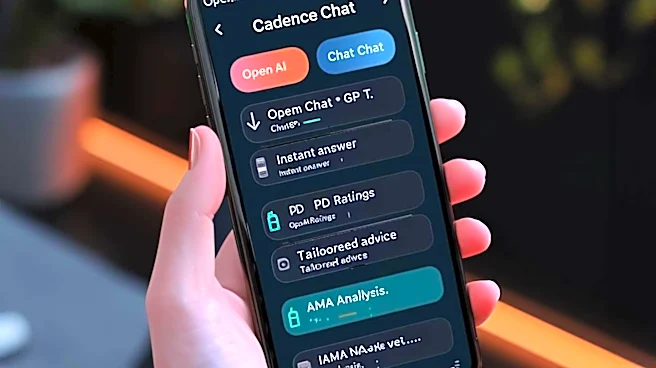
rising to 66% for Gen Z and 53% for millennials. Users are leveraging AI for various purposes, including getting advice about conversations, planning date ideas, practicing interactions, writing dating profiles and messages, and vetting the authenticity of profiles or photos. Some individuals use AI as a 'wingman' for pep talks or to analyze potential matches. While many find AI helpful for overcoming the pressures of online dating and crafting engaging messages, there's also a recognition that over-reliance could diminish personal authenticity. The trend highlights a significant shift in how individuals approach romantic connections in the digital age.
Why It's Important?
The integration of AI into online dating has significant implications for social interactions and relationship formation in the U.S. It reflects a broader societal trend of relying on technology to mediate personal experiences. For individuals, AI can act as a tool to boost confidence, refine communication skills, and streamline the often-overwhelming process of online dating. This could potentially lead to more successful initial connections by helping users present themselves more effectively. However, it also raises concerns about authenticity and genuine human connection. If individuals rely too heavily on AI to craft their personas or messages, it could create a disconnect between the online representation and the real person, potentially leading to disappointment or mistrust when meeting in person. The trend also highlights the increasing pressure individuals feel to perform optimally in online social settings, with AI offering a perceived advantage.
What's Next?
As AI technology continues to advance, its role in online dating is likely to become even more sophisticated. We may see AI tools offering more personalized coaching, real-time feedback during conversations, or even acting as matchmakers by analyzing compatibility beyond basic profile data. Dating platforms themselves might integrate AI more deeply to enhance user experience, perhaps by offering AI-powered icebreakers or profile optimization suggestions. However, there will also be a growing debate about the ethical boundaries of AI in personal relationships. Companies like Match Group are already taking a 'hard stance' against 'bot-to-bot' dating, where AI assistants communicate on behalf of users before any human interaction. This indicates a future where the industry will grapple with balancing technological innovation with the preservation of genuine human connection and authenticity in dating.
Beyond the Headlines
The use of AI in dating extends beyond mere convenience; it touches upon deeper psychological and sociological aspects of human connection. The reliance on AI to craft messages or vet profiles could inadvertently diminish individuals' own social skills and emotional intelligence, as they outsource critical aspects of interpersonal communication. This raises questions about the long-term impact on empathy, vulnerability, and the ability to form authentic bonds. Furthermore, the 'gamification' of dating, already prevalent in app culture, could be intensified by AI, turning the search for a partner into an optimized, algorithm-driven process rather than an organic human experience. There's also the potential for AI to perpetuate biases if not carefully designed, influencing who users are matched with or how they perceive potential partners. Ultimately, the trend forces a re-evaluation of what constitutes genuine connection and how technology shapes our most intimate relationships.