








What's Happening?
A recent study published in iScience indicates that human reaction times may be faster during exhalation or when holding one's breath compared to inhalation. Researchers, including Ken Paller and Erika Yamazaki from Northwestern University, observed this
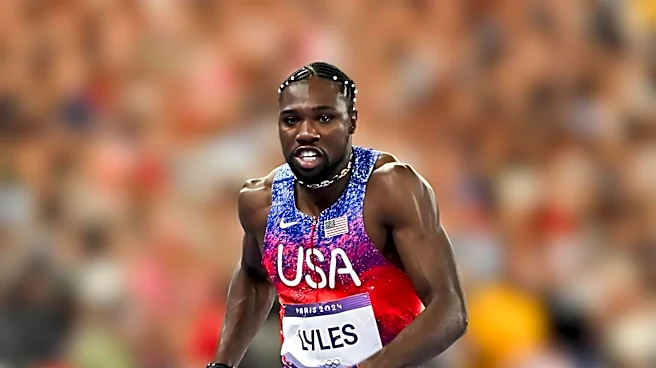
phenomenon in a button-clicking experiment involving 35 volunteers. On average, reaction times were 41 milliseconds quicker during exhalation. This finding remained consistent regardless of the volunteers' alertness levels. The study highlights that such a seemingly small difference could be significant in high-stakes events, citing that 41 milliseconds would have altered Noah Lyles's outcome in the 2024 Olympic men’s 100-meter final from a win to a fourth-place finish. The mechanism behind this breath-brain relationship is not yet fully understood, though previous research suggests a synchronization between breath and brain waves.
Why It's Important?
This research has significant implications for fields requiring rapid responses, such as competitive sports, emergency services, and even certain industrial operations. In sports, where victories are often decided by fractions of a second, understanding and potentially optimizing breathing patterns could offer a new avenue for performance enhancement. Athletes and coaches might explore incorporating specific breathing techniques into training regimens to improve reaction times. Beyond sports, professions where quick decisions are critical, such as pilots, surgeons, or first responders, could potentially benefit from training that leverages these findings. The study also opens up new avenues for neurological research, deepening our understanding of the intricate connections between physiological processes like breathing and cognitive functions like reaction time. This could lead to novel strategies for improving human performance and safety in various high-pressure environments.
What's Next?
Further research is needed to fully understand the underlying neurological mechanisms that link breathing patterns to reaction times. Scientists may explore how different types of breathing exercises or controlled breathing techniques could be integrated into training programs for athletes and professionals in critical roles. There could be investigations into whether these findings apply universally across different tasks and populations, or if specific contexts yield varying results. Additionally, the development of biofeedback tools that monitor breathing and provide real-time guidance for optimal reaction times might emerge. The sports science community is likely to closely examine these findings, potentially leading to new coaching methodologies aimed at harnessing the power of breath for competitive advantage. The long-term goal would be to translate this scientific insight into practical applications that enhance human performance and safety.
Beyond the Headlines
The study subtly underscores the profound and often overlooked connection between our most basic physiological functions and our peak cognitive abilities. It challenges the perception that reaction time is solely a matter of innate speed or intense training, suggesting that even involuntary actions like breathing play a critical role. This could lead to a more holistic approach to performance optimization, moving beyond purely physical or mental conditioning to integrate deeper physiological awareness. Ethically, it raises questions about the boundaries of performance enhancement and whether manipulating natural bodily functions for competitive gain is universally accepted. Culturally, it might foster a greater appreciation for practices that emphasize breath control, such as meditation or yoga, as not just tools for relaxation but also for enhancing cognitive and physical responsiveness. This research could spark a broader conversation about the subtle, yet powerful, ways our bodies influence our minds and actions.