
What's Happening?
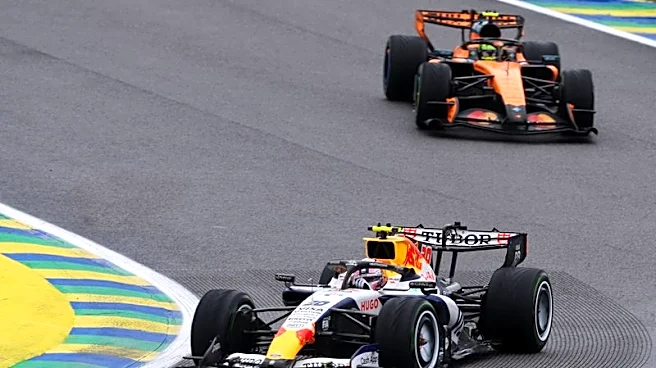
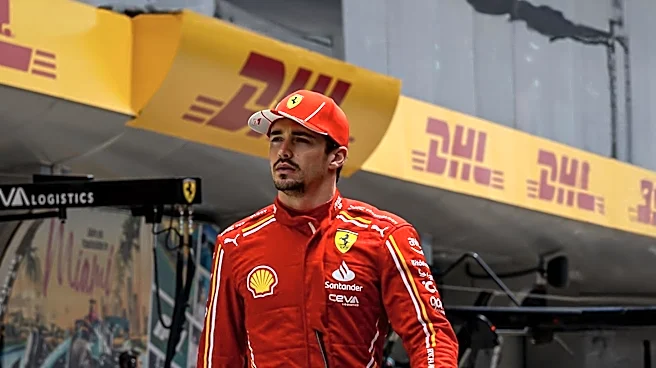
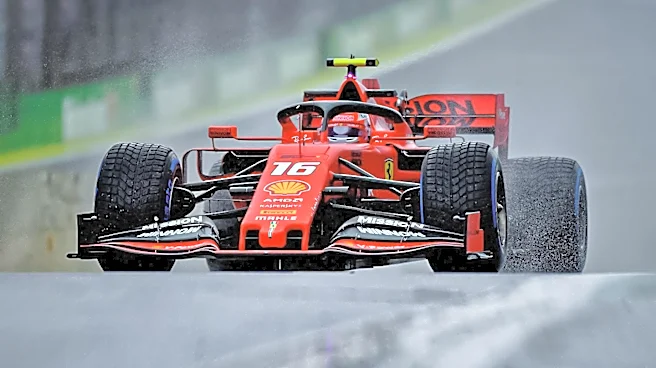
Charles Leclerc received a five-second time penalty following the Formula 1 Brazilian Grand Prix for making contact with Liam Lawson during an overtake. The incident occurred on the penultimate lap at the Turn
12 Juncao corner, where Leclerc's Ferrari touched Lawson's car. Although the contact was minor, stewards determined that it disrupted Lawson and allowed Leclerc to gain an advantage, ultimately leading to his overtake five corners later. Lawson reported that the contact damaged his car's rear left rim. As a result of the penalty, Leclerc dropped from seventh to eighth place, while Lawson was promoted from eighth to seventh. Lawson commented that the move was reminiscent of Leclerc's 'GP2 move' against Alex Albon nine years prior, where similar contact preceded an overtake.
Why It's Important?
This penalty underscores the strict enforcement of racing standards in Formula 1, particularly regarding contact during overtakes. Even minor contact that provides a sporting advantage can lead to penalties, affecting race results and championship points. For Liam Lawson, gaining a position due to the penalty is significant, as every point is crucial for drivers and teams in the highly competitive F1 season. For Charles Leclerc, the penalty means a loss of points and a lower finishing position, which can impact his standing in the drivers' championship and Ferrari's position in the constructors' championship. The stewards' decision reinforces the principle that drivers are responsible for avoiding collisions, especially when the other driver has the right to the corner. This incident also highlights the ongoing debate about what constitutes acceptable racing aggression versus an unfair advantage gained through contact.
What's Next?
The immediate consequence is the revised official result of the Brazilian Grand Prix, with Lawson gaining a point and Leclerc losing one. This specific incident is now closed, as the stewards have made their ruling. However, such penalties contribute to the precedent for future on-track incidents, influencing how drivers approach overtakes and how stewards interpret contact. Drivers and teams will review the decision to understand the boundaries of acceptable racing behavior. The incident may also be discussed in driver briefings to clarify expectations regarding wheel-to-wheel racing. For Leclerc, it serves as a reminder to be more cautious in close-quarters battles, while for Lawson, it validates his complaint and rewards his on-track performance.
Beyond the Headlines
The penalty against Charles Leclerc, and Lawson's comparison to a past incident, touches upon the broader discussion of driver reputation and driving styles in Formula 1. Leclerc's history of aggressive maneuvers, as highlighted by Lawson's 'GP2 move' comment, can influence how stewards perceive his actions in future incidents. This perception can be a double-edged sword: while aggressive driving can lead to spectacular overtakes, it also carries a higher risk of penalties. The incident also brings to light the subjective nature of stewarding, where the degree of contact and its impact on the race can be open to interpretation. The outcome reinforces the idea that even seemingly minor infringements can have tangible consequences, emphasizing the fine margins that define success and failure in Formula 1. It also contributes to the narrative around driver conduct and sportsmanship in elite motorsport.