










What's Happening?
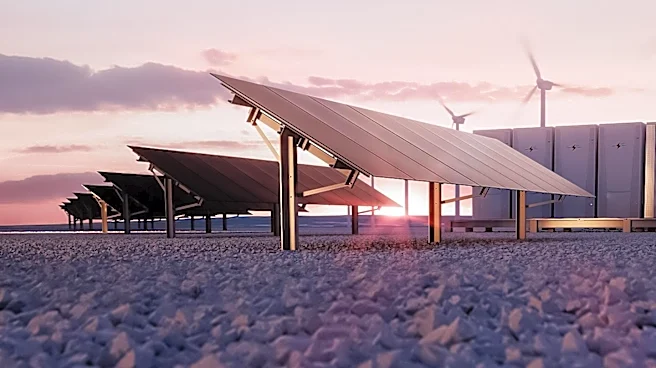
Researchers and engineers are exploring alternative battery technologies to enhance renewable energy storage capabilities. In the United Arab Emirates, a massive clean energy project combines solar power with battery storage to supply energy to half a million
homes. Meanwhile, in the U.S., the National Renewable Energy Laboratory is developing miniature batteries for electronic tags. These efforts aim to reduce reliance on traditional lithium-ion batteries, which require critical minerals like lithium, cobalt, and nickel. Alternative technologies, such as molten salt and liquid air storage, offer sustainable solutions by storing energy in different forms. These innovations are designed to provide long-term energy storage without the environmental impact associated with conventional batteries.
Why It's Important?
The development of alternative battery technologies is crucial for the future of renewable energy. As the demand for clean energy grows, the need for efficient and sustainable storage solutions becomes more pressing. Traditional lithium-ion batteries, while effective, pose environmental challenges due to the extraction of critical minerals. By exploring alternatives like molten salt and liquid air storage, researchers aim to create more sustainable energy systems. These technologies could significantly reduce the carbon footprint of energy storage and provide reliable power sources for various applications, from wearable technology to industrial processes. The shift towards alternative batteries could also alleviate the geopolitical tensions associated with mineral extraction.
What's Next?
As these alternative battery technologies continue to develop, their implementation in large-scale energy projects is expected to increase. The success of projects like the Crescent Dunes in Nevada and the Carrington cryobattery in the UK could pave the way for broader adoption. Researchers will likely focus on improving the efficiency and scalability of these technologies to meet global energy demands. Additionally, policymakers and industry leaders may need to address regulatory and infrastructure challenges to facilitate the integration of these new storage solutions into existing energy systems. The transition to alternative batteries could also drive innovation in related fields, such as materials science and energy management.
Beyond the Headlines
The exploration of alternative battery technologies highlights the broader shift towards sustainable energy solutions. These innovations not only address environmental concerns but also have the potential to transform energy markets and industrial practices. By reducing dependency on critical minerals, these technologies could lead to more equitable and environmentally friendly energy systems. Furthermore, the development of new storage solutions may inspire further research into unconventional energy sources, such as human sweat, which is being investigated as a power source for wearable devices. This trend towards sustainability reflects a growing recognition of the need for holistic approaches to energy production and consumption.