






What's Happening?
Olix, a London-based artificial intelligence company, has successfully raised $312 million in a Series B funding round. The investment was led by notable firms including Fundomo, Arm, and Hudson River Trading, with participation from Reed Hastings, co-founder
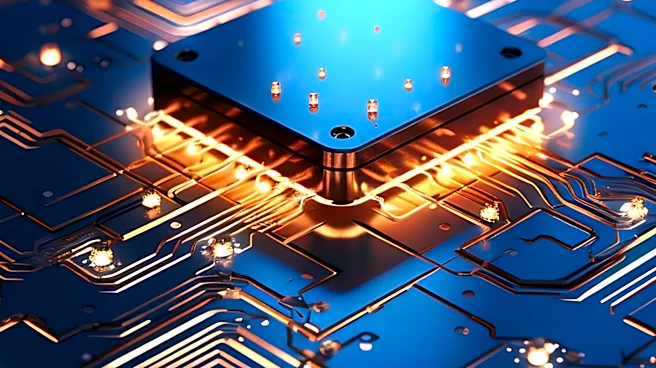
of Netflix. This funding round has elevated Olix's valuation to $3.3 billion. Founded in 2024, Olix plans to utilize the new capital to develop its DX-1 AI chip, which is expected to be available to customers in the second half of 2027. The company is focusing on creating specialized chips for AI inference processes, aiming to enhance performance and reduce energy consumption. Olix's approach involves distributing AI models across multiple specialized chips rather than relying on a single powerful chip, which is intended to improve efficiency and scalability.
Why It's Important?
The investment in Olix highlights the growing interest and financial backing in AI technology, particularly in the development of specialized hardware to support AI applications. As AI continues to expand across various industries, the demand for efficient and powerful processing capabilities is increasing. Olix's focus on creating chips that optimize AI inference processes could significantly impact the AI hardware market, offering more cost-effective and energy-efficient solutions. This development is crucial for industries relying on large-scale AI models, as it promises to lower operational costs and improve performance. The involvement of high-profile investors like Reed Hastings underscores the potential of Olix's technology to influence the future of AI infrastructure.
What's Next?
Olix plans to continue its development of the DX-1 chip and expand its production infrastructure. The company aims to deliver its AI chip to customers by late 2027, which could position it as a key player in the AI hardware market. As Olix progresses, it may attract further investment and partnerships, potentially leading to collaborations with major tech companies seeking to enhance their AI capabilities. The success of Olix's chip could also prompt other companies to invest in similar technologies, driving innovation and competition in the AI hardware sector.