
What's Happening?
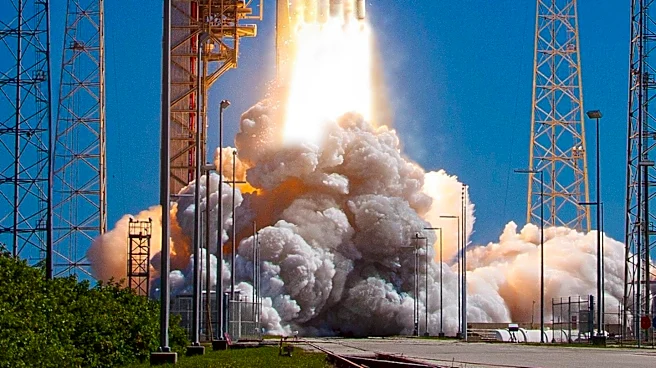
A United Launch Alliance (ULA) Vulcan Centaur rocket experienced a total mission failure approximately 10 minutes into its flight, leading to the loss of all cargo, including 40 Leo communications satellites
for Amazon. This incident marks ULA's first total mission failure in its history as a space company. The launch, which occurred on November 15, was intended to be ULA's return to flight after a nine-month pause due to an anomaly with a previous Vulcan Centaur rocket. Initial investigations suggest the problem lies with the Vulcan first stage, specifically its fuel supply to the BE-4 engines, rather than the engines themselves. The first stage reportedly failed to accelerate the vehicle sufficiently for the Centaur second stage to lift the payload into orbit. The RL10 boosters and the Centaur second stage are believed to have performed nominally.
Why It's Important?
This mission failure significantly impacts Amazon's ambitions to establish a satellite communications system, Project Kuiper, to compete with SpaceX's Starlink. Amazon had invested billions to reserve launches on 38 Vulcan Centaur rockets, among others, to accelerate the deployment of its Leo satellites. The unreliability of the Vulcan Centaur now poses a substantial setback, potentially delaying Amazon's entry into the satellite internet market and allowing SpaceX to further solidify its lead. Furthermore, the incident raises concerns for other space companies that rely on ULA as an alternative to SpaceX, especially given the impending retirement of SpaceX's Falcon 9 rocket. The potential implication for Blue Origin's New Glenn rocket, which uses the same BE-4 engines, also adds to the uncertainty within the commercial space launch industry, although ULA's preliminary findings point to a fuel supply issue rather than the engines themselves.
What's Next?
ULA is currently investigating the cause of the Vulcan rocket's failure, with preliminary indications pointing to a fuel supply issue in the first stage. Until the problem is fully resolved, Amazon faces significant challenges in deploying its Leo satellites, as its primary launch options, including ULA's Vulcan Centaur and the limited remaining Atlas V rockets, are now compromised. SpaceX's Falcon 9 launches are booked through 2028, and the company does not plan to add more. The outcome of ULA's investigation will determine the timeline for future Vulcan launches and could influence the operational status of Blue Origin's New Glenn rocket. Amazon will need to reassess its launch strategy and potentially seek alternative solutions to advance its satellite internet project.
Beyond the Headlines
The failure of the ULA Vulcan rocket underscores the inherent risks and complexities of space exploration and commercial satellite deployment. Beyond the immediate financial losses for Amazon and ULA, this event highlights the critical need for robust and diversified launch capabilities within the U.S. space industry. The incident could lead to increased scrutiny of rocket engine and fuel system designs, potentially influencing future regulatory standards and development processes. It also emphasizes the competitive dynamics between established aerospace companies and newer players like SpaceX, where reliability and consistent launch access are paramount. The long-term implications could include a re-evaluation of supply chain dependencies for critical rocket components and a renewed focus on redundancy in launch services to mitigate such setbacks.