





What's Happening?
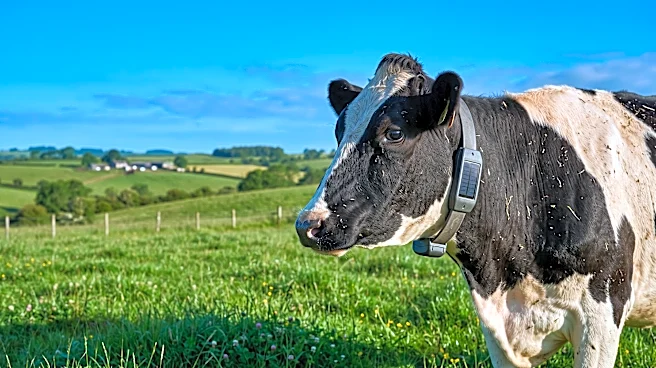
Halter, an agtech company, is deploying solar-powered smart collars for cattle in the United States, alongside New Zealand and Australia. These collars utilize LoRaWAN connectivity to provide farmers and ranchers with virtual fencing, real-time herd monitoring,
and remote pasture management capabilities via a smartphone or tablet. This technology aims to replace traditional physical fencing and manual mustering, which are labor-intensive and costly. The system operates on LoRaWAN infrastructure, using solar-powered gateway infrastructure and towers to ensure long-range, low-power connectivity even in remote rural areas without reliable mains power or mobile network coverage. Halter reports over 2,000 customers and more than one million collars deployed across its operational regions, including the U.S. The CEO of the LoRa Alliance, Alper Yegin, highlighted LoRaWAN's accessibility and strong ecosystem as key factors enabling smart agriculture solutions.
Why It's Important?
The introduction of Halter's smart cattle monitoring system in the U.S. signifies a significant advancement in agricultural technology, particularly for the livestock industry. This innovation can lead to substantial improvements in operational efficiency and animal welfare for American farmers and ranchers. By enabling virtual fencing and remote monitoring, the technology reduces the need for extensive physical infrastructure and manual labor, potentially lowering operational costs and freeing up farmers' time. Enhanced real-time visibility into herd location and health can also lead to better grazing management, optimizing land use and promoting healthier livestock. This development is crucial for the U.S. agricultural sector, which often deals with vast, remote grazing lands where traditional methods are inefficient. The adoption of LoRaWAN technology further underscores a broader trend towards integrating low-power wide-area networks into smart agriculture, making advanced solutions accessible even in areas with limited connectivity.
What's Next?
The continued expansion and adoption of Halter's smart collar technology in the U.S. are anticipated, with potential for further integration into the broader smart agriculture ecosystem. As more farmers and ranchers recognize the benefits of virtual fencing and remote monitoring, the demand for such solutions is likely to grow. This could lead to increased investment in LoRaWAN infrastructure across rural American landscapes, supporting not only livestock tracking but also other smart agriculture applications like soil and irrigation monitoring. The success of Halter's deployment may also encourage other agtech companies to develop and introduce similar innovative solutions, fostering a more technologically advanced and efficient agricultural sector. Furthermore, the data collected from these smart collars could provide valuable insights for optimizing farming practices, potentially influencing future agricultural policies and best practices related to land management and animal welfare.
Beyond the Headlines
Beyond the immediate benefits of efficiency and animal welfare, Halter's technology could trigger deeper shifts in the U.S. agricultural landscape. The move towards virtual fencing challenges traditional notions of land ownership and management, potentially leading to new regulatory frameworks for livestock containment and grazing rights. The reliance on data and remote management also raises questions about data privacy and security for farmers, as sensitive information about their operations becomes digitized. Ethically, the technology could redefine the relationship between humans and livestock, moving towards a more data-driven approach to animal care. In the long term, widespread adoption could contribute to more sustainable farming practices by optimizing resource use and reducing environmental impact associated with traditional fencing and manual labor. This technological shift could also attract a new generation of tech-savvy individuals to farming, transforming the demographic and skill sets required in the agricultural workforce.