







What's Happening?
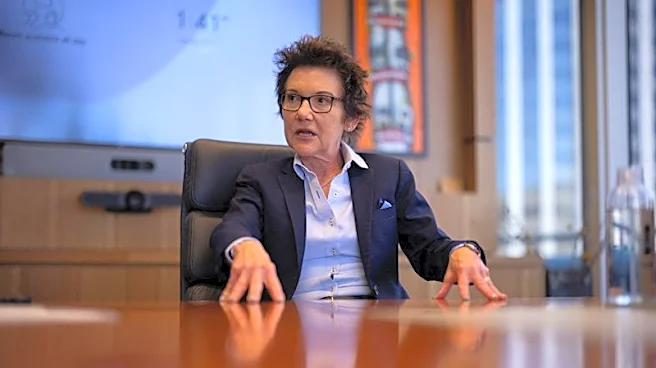
Susan Collins, the president of the Boston Federal Reserve, indicated on Tuesday that the central bank might need to raise interest rates again before the end of the year. This statement comes as inflation continues to remain above the Federal Reserve's
target. Speaking at the 25th Annual Regional and Community Bankers Conference, Collins stated that it would be "appropriate" to increase rates "a bit further" to bring inflation back down to the 2% target. She clarified that her view would depend on the totality of incoming economic data and the associated balance of risks. Collins, a member of the Federal Open Market Committee, supported the previous month's decision to raise the federal funds rate by 25 basis points, setting it between 3.75% and 4.00%. Her "modal outlook" anticipates healthy GDP growth and a labor market near full employment, but she also highlighted inflation risks stemming from stronger-than-expected AI-related demand and elevated energy prices.
Why It's Important?
President Collins' remarks are significant for the U.S. economy as they signal the Federal Reserve's continued hawkish stance on monetary policy in its effort to combat inflation. Further interest rate hikes would directly impact borrowing costs for consumers and businesses, potentially slowing economic growth but aiming to stabilize prices. Industries reliant on borrowing, such as housing and automotive, could face increased pressure. For investors, the prospect of higher rates influences bond yields and stock market valuations. The mention of AI-related demand as an inflation risk is particularly noteworthy, suggesting that the rapid expansion of artificial intelligence technologies is now being factored into monetary policy considerations, potentially driving up energy consumption and associated costs. This highlights a new dimension in inflation analysis, linking technological advancement to macroeconomic stability. Businesses and individuals should prepare for a potentially tighter credit environment and continued vigilance from the Federal Reserve regarding inflation.
What's Next?
The Federal Reserve will continue to monitor incoming economic data, including inflation reports, employment figures, and GDP growth, to inform its decisions on interest rates. President Collins' statement suggests that another rate hike before year-end is a strong possibility, though not a certainty, as it remains contingent on economic developments. Market participants, including investors and businesses, will closely watch upcoming Federal Open Market Committee meetings for further guidance. The odds of another rate hike are being actively discussed in financial markets, with some platforms indicating a high probability for a December increase. Businesses should assess their financial strategies in anticipation of potentially higher borrowing costs, while consumers may see continued impacts on mortgage rates and other loans. The Federal Reserve's actions will aim to navigate the delicate balance between curbing inflation and avoiding a significant economic downturn.
Beyond the Headlines
The Federal Reserve's consideration of AI-related demand as an inflation risk points to a deeper, evolving challenge in economic policy. The rapid growth of AI technologies, while promising for productivity, could create new inflationary pressures through increased demand for energy, specialized hardware, and skilled labor. This suggests that future monetary policy might need to account for technological shifts more explicitly. Furthermore, the ongoing debate about interest rates reflects a broader tension between economic growth and price stability. The Federal Reserve's mandate to achieve both full employment and stable prices becomes increasingly complex in an economy undergoing significant technological transformation and facing global supply chain dynamics. The long-term implications could include a re-evaluation of how economic models incorporate technological advancements and their potential impact on inflation, moving beyond traditional factors like wage growth and commodity prices to include the energy and resource demands of emerging technologies.