





What's Happening?
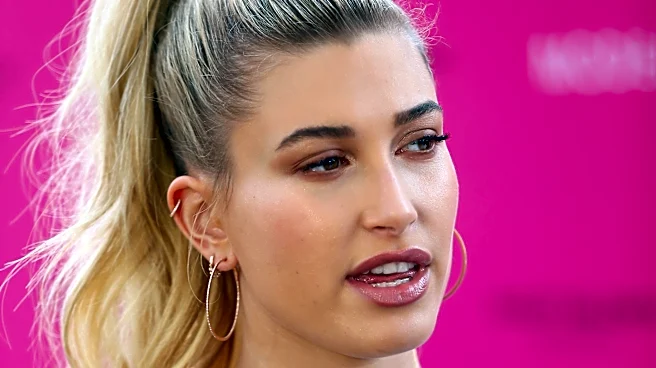
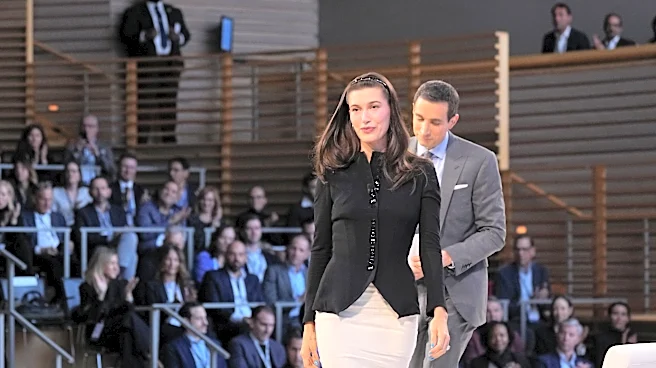
Hailey Bieber, founder of Rhode, has addressed criticism regarding her use of the term 'optimistical delusion' during a recent appearance at the New York Times’ DealBook Summit on November 18. Bieber stated that this mindset was crucial in her goal to
sell her beauty company for a billion dollars, a figure she described as 'shooting for the stars.' Following her remarks, internet users questioned the validity of the word 'optimistical.' In response, Bieber shared a screenshot on her Instagram Stories on November 20, displaying a dictionary definition of 'optimistical' as 'a version of optimistic,' effectively defending her word choice against online detractors. This incident occurred as Bieber discussed the May 2025 sale of her beauty company, emphasizing the ambitious financial target she set for the transaction.
Why It's Important?
This event highlights the intense public scrutiny faced by high-profile figures in the business and entertainment sectors, particularly concerning their public statements and entrepreneurial ventures. Bieber's defense of her vocabulary choice underscores a broader trend where public figures are increasingly challenged on social media for perceived linguistic inaccuracies or unconventional phrasing. For entrepreneurs, her story emphasizes the role of ambitious goal-setting and a positive, albeit perhaps unconventional, mindset in achieving significant business milestones. The rapid online reaction and subsequent defense also illustrate the immediate and pervasive nature of social media commentary, which can quickly amplify both support and criticism for public figures and their brands. This dynamic can influence public perception and brand image, making effective communication and response strategies crucial for individuals in the public eye.
What's Next?
While the immediate controversy over Bieber's word choice appears to be resolved with her dictionary-backed defense, the broader implications for public figures and their communication strategies remain. It is likely that other public figures will continue to face similar scrutiny over their language, prompting a need for careful consideration of word choice in public forums. For Bieber, the focus will likely shift back to the upcoming May 2025 sale of her beauty company, Rhode, and the business strategies that will lead to that transaction. Her continued engagement with her audience, whether through social media or public appearances, will be watched for further insights into her entrepreneurial journey and her approach to navigating public opinion. The incident may also encourage a more nuanced discussion about language evolution and usage in contemporary discourse.
Beyond the Headlines
Beyond the immediate linguistic debate, this incident touches upon the intersection of celebrity, entrepreneurship, and public perception in the digital age. The concept of 'optimistical delusion' as a driver for achieving extraordinary business goals offers an interesting perspective on entrepreneurial mindset, suggesting that a degree of audacious belief, even if perceived as unrealistic by some, can be a powerful motivator. This also reflects on the evolving nature of language and how public figures can influence or challenge conventional usage. The swift online backlash and Bieber's equally swift, evidence-based rebuttal highlight the constant pressure on public figures to be articulate and precise, while also demonstrating the power of direct engagement to manage public narratives. This scenario underscores the ongoing cultural conversation about authenticity, ambition, and the role of social media in shaping public discourse around prominent individuals.