





What's Happening?
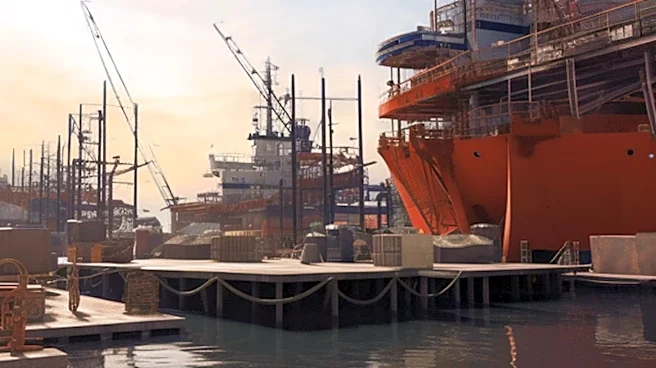
Japan has officially approved the initial projects under its new shipbuilding revival fund, allocating up to ¥213.1 billion ($1.36 billion) to three major shipyard groups. This move signifies Tokyo's transition from policy discussions to substantial investment
in its shipbuilding capacity. The Ministry of Land, Infrastructure, Transport and Tourism has sanctioned plans submitted by Imabari Shipbuilding, Japan Marine United, and Namura Shipbuilding, covering the fiscal years 2026 through 2034. The allocated funds are earmarked for significant production enhancements, including dock expansions, new cranes, automation technologies, and labor-saving equipment. This initiative is a direct response to Japan's strategic goal of doubling its annual shipbuilding capacity from approximately 9 million gross tons to 18 million gross tons by 2035, aiming to reclaim market share lost to competitors like China and South Korea.
Why It's Important?
This substantial investment underscores Japan's commitment to bolstering its economic security and industrial policy through the revitalization of its shipbuilding sector. The allocation of $1.36 billion to key industry players like Imabari Shipbuilding, Japan Marine United, and Namura Shipbuilding is expected to catalyze significant modernization and expansion within these facilities. The goal to double shipbuilding capacity by 2035 reflects a broader national strategy to enhance industrial competitiveness and reduce reliance on foreign shipbuilding. This move could lead to increased domestic job creation, technological advancements in maritime manufacturing, and a stronger position for Japan in the global shipping industry. The consolidation within the industry, exemplified by Imabari's acquisition of a 60% stake in JMU, further strengthens Japan's ability to compete on a larger scale, potentially impacting global trade routes and maritime logistics.
What's Next?
The approved funding represents the first phase of a broader initiative, with further applications for support currently under consideration. The Ministry of Land, Infrastructure, Transport and Tourism anticipates that these three programs alone will mobilize approximately ¥600 billion ($3.84 billion) in public and private investment over the next decade, leading to a roughly 50% increase in the combined construction capacity of the participating groups. This suggests a sustained period of growth and modernization for Japan's shipbuilding industry. The focus on production upgrades, including automation and labor-saving equipment, indicates a strategic shift towards more efficient and technologically advanced shipbuilding practices. As Japan continues to invest in this sector, it is expected to see a significant increase in its order book, particularly for bulk carriers, which currently constitute a large portion of the country's existing orders.
Beyond the Headlines
The strategic decision to invest heavily in shipbuilding goes beyond mere economic growth; it reflects Japan's long-term vision for economic security and industrial resilience. By prioritizing shipbuilding, Tokyo is addressing decades of market share erosion to China and South Korea, aiming to re-establish itself as a dominant force in the global maritime industry. This initiative could also have broader implications for global supply chains, potentially offering more diversified options for ship construction and reducing dependency on a few major players. The emphasis on advanced technology and automation within the shipyards suggests a move towards a more sustainable and high-tech manufacturing base, which could set new standards for the industry worldwide. This strategic pivot highlights the critical role of industrial policy in national security and economic stability in an increasingly competitive global landscape.