


What's Happening?
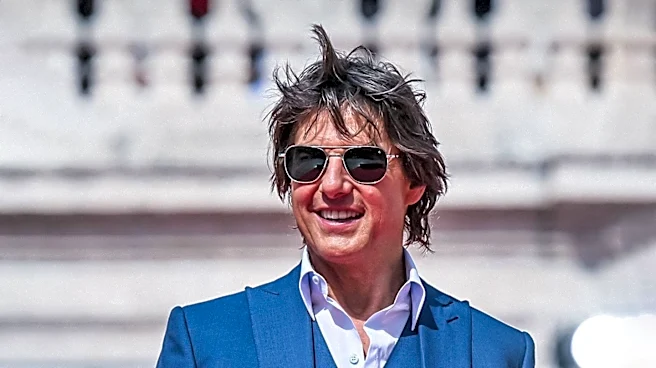
Ten years after its release, Tom Cruise's portrayal of Jack Reacher in 'Jack Reacher: Never Go Back' is being re-examined, highlighting the initial controversy and subsequent audience reception. When Cruise was cast as Jack Reacher in 2012, it sparked
significant debate among fans of Lee Child's novels, who envisioned a character much taller and more muscular than Cruise. Despite this physical disparity, Cruise, alongside director Christopher McQuarrie, successfully adapted the novel 'One Shot' into a film that garnered positive reviews and strong box office performance. The sequel, 'Jack Reacher: Never Go Back,' released on October 21, 2016, saw Cruise reprise the role, with Edward Zwick directing and McQuarrie producing. This film followed Reacher as he became a fugitive with an Army major framed for espionage, uncovering a conspiracy. While the sequel experienced a drop in critical and audience scores compared to its predecessor, it still demonstrated Cruise's ability to lead an action film, even in a role many considered him miscast for. The discussion now often contrasts Cruise's interpretation with Alan Ritchson's physically accurate portrayal in the Prime Video series 'Reacher,' which has been well-received by book fans.
Why It's Important?
The ongoing discussion about Tom Cruise's Jack Reacher films underscores a significant dynamic in Hollywood adaptations: the balance between source material fidelity and star power. Cruise's casting, despite not aligning with the physical description of the literary character, leveraged his established reputation as an action star to draw a broad audience. This approach proved commercially successful, with the first film grossing $218.3 million on a $60 million budget. The subsequent success of the 'Reacher' TV series, which features an actor physically closer to the book's description, highlights that there is an audience for both interpretations. This situation demonstrates that while book fans often prioritize accuracy, a compelling performance and strong narrative can transcend physical discrepancies for a wider movie-going audience. It also illustrates the evolving landscape of media consumption, where both cinematic and television adaptations can coexist and cater to different fan bases, each finding success through distinct approaches to character portrayal.
What's Next?
The continued success of the 'Reacher' television series, with two more seasons reportedly in development, suggests that the physically accurate portrayal of Jack Reacher by Alan Ritchson will remain prominent. This could further solidify the TV series as the definitive adaptation for fans prioritizing fidelity to Lee Child's original character description. For Tom Cruise, his involvement in other major franchises, such as 'Mission: Impossible,' indicates his continued focus on high-octane action roles where his star power is a primary draw. While there are no immediate plans for Cruise to return as Jack Reacher, the ongoing conversation about his past portrayal could influence future casting decisions in adaptations of popular literary characters. The dual success of both the Cruise films and the Ritchson series may encourage studios to explore diverse adaptation strategies, potentially leading to more parallel interpretations of beloved characters across different media platforms.
Beyond the Headlines
The 'Jack Reacher' casting debate delves into deeper questions about the nature of adaptation and audience expectations. It highlights the tension between an author's original vision and a filmmaker's interpretation, especially when a major star is involved. For many book readers, the physical attributes of a character are integral to their identity, making deviations a point of contention. However, for general moviegoers, charisma, acting prowess, and the overall quality of the action and story often take precedence. This scenario also touches upon the concept of 'suspension of disbelief' and how far audiences are willing to stretch it for a compelling narrative. The existence of two successful, yet distinct, interpretations of Jack Reacher suggests that character essence can be captured in multiple ways, challenging the notion that there is only one 'correct' way to adapt a beloved literary figure. It underscores the subjective nature of character perception and the diverse demands of different media audiences.