


What's Happening?
Leash Biosciences, an AI infrastructure company based in Salt Lake City, has successfully raised $11 million in a financing round. The funding was co-led by Innovation Endeavors and Insight Partners. This capital injection is earmarked to expand Leash Biosciences'
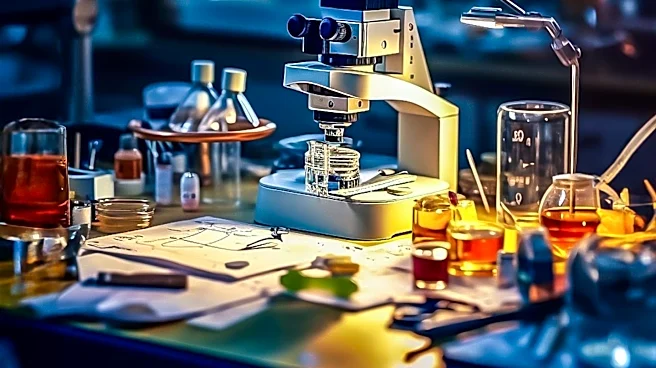
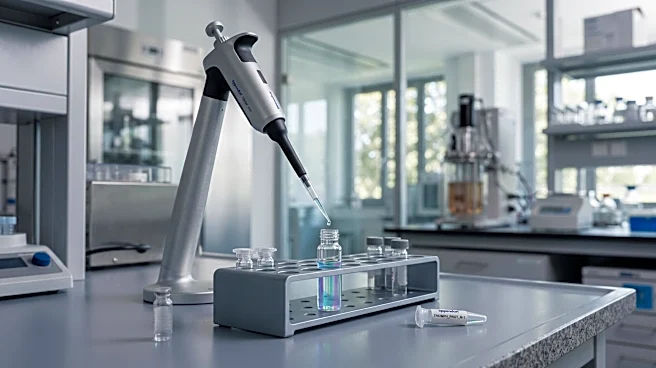
experimental data production and enhance its environments for evaluating and training AI systems, with an initial focus on chemistry and biology. The company addresses a critical need for AI agents to improve scientific decision-making by providing opportunities to conduct experiments and learn from outcomes at computational speeds, circumventing the lengthy timelines of physical experiments. Leash Biosciences operates an automated laboratory that generates massive biochemical datasets, having designed and tested 6.3 million molecules and accumulated over 44 billion experimental measurements across nearly 1,000 protein targets. This unique approach combines automated laboratory screening with software for AI evaluation and training, enabling developers to refine AI models based on real experimental feedback.
Why It's Important?
This funding round is significant for the advancement of AI in drug discovery and scientific research. By creating a 'school for AI scientists' through the generation of purpose-built experimental data, Leash Biosciences is addressing a fundamental limitation in current AI models, which often rely on data not originally collected for model training. The ability to rapidly test and refine AI hypotheses against real experimental outcomes could dramatically accelerate the pace of scientific discovery, particularly in the pharmaceutical sector. This development could lead to more efficient identification of new medicines and a deeper understanding of biological processes. The investment from prominent firms like Insight Partners underscores the growing recognition of the critical role of high-quality, scalable experimental data in building performant AI systems for scientific applications. This could position Leash Biosciences as a foundational infrastructure provider for the next generation of scientific AI.
What's Next?
With the new funding, Leash Biosciences plans to broaden its scope beyond protein-molecule binding to include additional types of biological experiments. This expansion will create a wider array of tasks for AI evaluation and training, fostering new partnerships with AI developers and pharmaceutical companies. The company has already demonstrated the efficacy of its approach with Minos, a set of virtual research environments, where AI agents completed approximately 100,000 independent experimental sequences in six weeks, revealing limitations in current AI drug discovery strategies. Leash Biosciences has publicly released research preprints and environments to aid researchers in improving AI performance in life sciences and anticipates releasing further results showcasing significant model performance improvements. These next steps suggest a continued push towards integrating AI more deeply into the scientific method, potentially leading to breakthroughs in various biological and chemical domains.
Beyond the Headlines
The work of Leash Biosciences represents a paradigm shift in how scientific research, particularly drug discovery, can be conducted. By creating controlled, data-rich environments where AI agents can learn and evolve, the company is not just optimizing existing processes but fundamentally altering the scientific inquiry process. This approach raises profound implications for the future of scientific labor, potentially augmenting or even transforming the role of human scientists by allowing AI to explore vast experimental spaces with unprecedented speed and precision. Ethically, the development of AI systems that can independently design and execute experiments necessitates careful consideration of validation, reproducibility, and the potential for unforeseen outcomes. Legally, the intellectual property generated by AI-driven discovery processes will likely become a complex area of debate. Culturally, this advancement could foster a new era of interdisciplinary collaboration between AI specialists, biologists, and chemists, pushing the boundaries of what is scientifically possible.