







What's Happening?
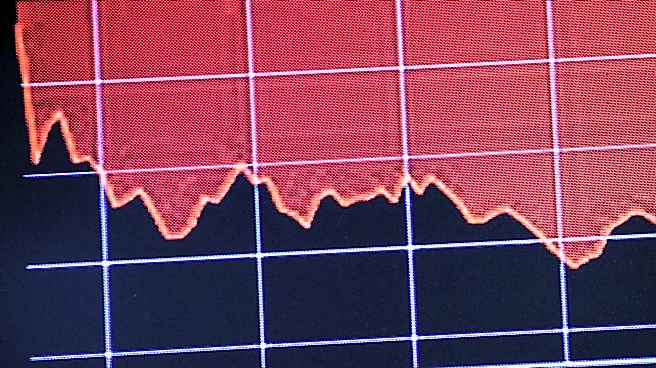
Global equity funds experienced a significant influx of $89.2 billion over the past week, marking a 20-week high, according to a new research report from Deutsche Bank. This surge in capital allocation occurred despite a sharp decline in global equity positioning,
which registered one of its steepest weekly drops on record. The bank's consolidated measure of equity positioning plummeted to the 20th percentile, driven primarily by discretionary investors whose positioning fell to the bottom 3% of its historical range. Systematic strategies also reduced their exposure to neutral. Technology stocks were at the epicenter of this sell-off, with sector positioning reaching lows unseen since 'Liberation Day,' implying negative tech earnings growth, even though the sector posted a 53% aggregate growth in the third quarter. While market speculation attributed the tech sell-off to a 'blue sweep' in the U.S. mid-terms and fears over data center expansion opposition, Deutsche Bank identified a 'forced positioning unwind' as the primary cause. Despite the overall decline in positioning, emerging markets led the inflows with a record $45.1 billion, with Chinese equities receiving $34.5 billion and Taiwan $8.6 billion. Technology funds also absorbed $14.5 billion, indicating strong dip-buying behavior.
Why It's Important?
This divergence between declining equity positioning and record fund inflows highlights a complex and potentially volatile market environment. The sharp drop in positioning, particularly among discretionary investors, suggests a significant shift in sentiment and a move towards risk aversion. This could indicate underlying concerns about future market performance or economic stability, despite strong corporate earnings reported by S&P 500 companies. The substantial inflows into emerging markets, especially China and Taiwan, suggest a reallocation of capital away from developed markets or specific sectors like U.S. technology, potentially driven by perceived value or growth opportunities elsewhere. The continued bullish stance of Deutsche Bank on the technology sector, despite the recent sell-off, suggests that some institutional investors view the current downturn as a buying opportunity, believing in the long-term fundamentals of tech companies. This dynamic could lead to increased market volatility as different investor groups react to conflicting signals, impacting U.S. investors and the broader financial landscape.
What's Next?
The market will likely continue to grapple with the tension between investor sentiment, as reflected in positioning, and actual capital flows. Deutsche Bank's reiterated 'overweight' rating on tech suggests that the bank anticipates a rebound in the sector, viewing the current collapse as creating a favorable risk-reward setup. This could encourage further dip-buying in technology stocks, potentially leading to a recovery if the underlying fundamentals remain strong. However, if the 'forced positioning unwind' continues or if broader economic concerns materialize, the market could experience further declines. The significant inflows into emerging markets, particularly China, could signal a sustained shift in global investment patterns, potentially impacting the relative performance of U.S. equities. Investors will be closely watching for further data on corporate earnings, economic indicators, and any shifts in central bank policies to gauge the future direction of the market and assess whether the current environment represents a temporary correction or a more significant trend reversal.
Beyond the Headlines
The phenomenon of declining equity positioning coinciding with record fund inflows points to a deeper market psychology at play. It suggests a potential disconnect between the short-term tactical decisions of some investors, who are reducing exposure, and the longer-term strategic allocations of others, who are deploying capital. This could be indicative of a 'smart money' versus 'retail money' dynamic, or simply different investment horizons and risk appetites among various market participants. The attribution of the tech sell-off to a 'forced positioning unwind' rather than solely to political events like the U.S. mid-terms highlights the complex interplay of technical market factors and broader geopolitical or economic narratives. This situation also raises questions about market efficiency and the speed at which information and sentiment are processed and reflected in asset prices. The continued strength of tech earnings, despite the sector's positioning decline, underscores the importance of fundamental analysis even amidst market turbulence, suggesting that underlying business performance can diverge from short-term market movements.