







What's Happening?
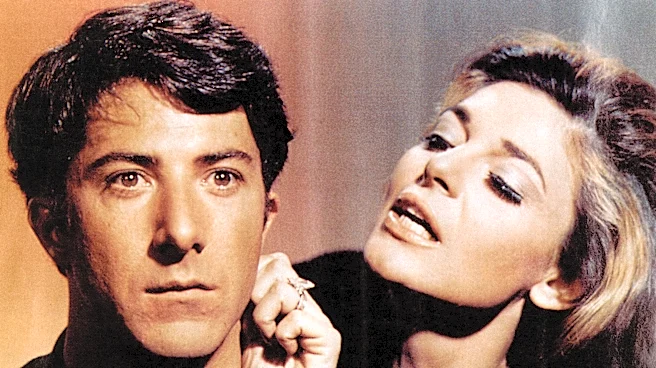
Dustin Hoffman has revealed that the filming of his breakout 1967 movie, 'The Graduate,' was a 'terrible experience.' In an essay adapted from his upcoming memoir, the 89-year-old actor recounted feeling insecure as a Jewish actor cast as the 'ultimate
Wasp,' Ben Braddock. He described director Mike Nichols' attempts to alter his appearance, which made Hoffman feel as though 'They're trying to take the Jew off my face.' Hoffman noted that Nichols, while 'wonderful' during rehearsals, became 'an entirely different person' once filming began, exhibiting 'a certain sadism.' He cited instances such as 27 unused takes of Katharine Ross slapping him and an underwater scene that resulted in a punctured eardrum. Hoffman believes Nichols was angry with him, either due to his performance or a perceived miscasting. He now views the film as a self-portrait for Nichols, with himself as a 'stand-in' for Nichols' self-loathing. His memoir, 'Look at Me,' is set to be released on November 10.
Why It's Important?
Dustin Hoffman's candid revelations about the 'brutal' filming of 'The Graduate' offer a significant re-evaluation of a classic American film and its production. This insight challenges the romanticized view often associated with iconic movies, exposing the personal and professional struggles behind the scenes. For film historians and enthusiasts, it provides a deeper understanding of the creative process and the complex dynamics between actors and directors. The discussion of Hoffman's insecurity as a Jewish actor in a role perceived as 'Wasp' highlights broader issues of identity, representation, and typecasting in Hollywood during that era. Furthermore, Nichols' alleged 'sadism' and Hoffman's physical injuries raise questions about directorial methods and actor welfare, issues that continue to be debated in the entertainment industry. This perspective could influence how 'The Graduate' is viewed and analyzed in the future, shifting focus from solely its artistic merit to also its human cost.
Beyond the Headlines
Beyond the immediate impact on the perception of 'The Graduate,' Hoffman's account touches upon deeper cultural and psychological themes. His feeling of 'They're trying to take the Jew off my face' speaks to the pressures of assimilation and the erasure of identity within the entertainment industry, particularly for minority actors in the mid-20th century. This struggle for authenticity versus the demands of a role or a director's vision is a timeless conflict for performers. The portrayal of Mike Nichols' alleged 'sadism' and self-loathing also invites a psychological examination of creative genius and its potential dark sides. It prompts reflection on whether artistic brilliance can sometimes be intertwined with personal torment or abusive behavior. Hoffman's memoir, 'Look at Me,' promises to offer a more comprehensive look into these experiences, potentially sparking broader conversations about mental health, power dynamics, and ethical conduct in creative fields, extending beyond the specific context of 'The Graduate' to the industry as a whole.