






What's Happening?
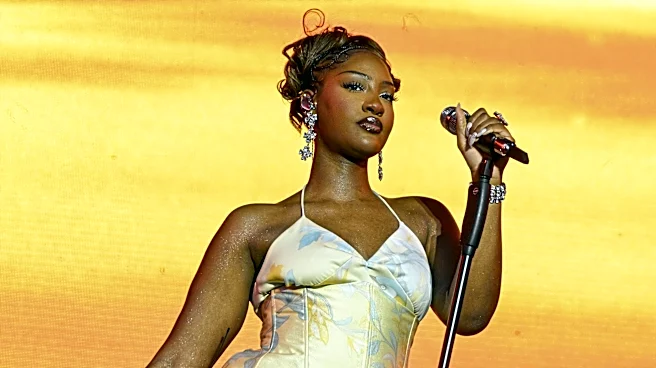
Nigerian singer Tems recently performed her first hometown show in over four years at Spotify's inaugural Surround Sound concert in Lagos. This performance follows the release of her Grammy-nominated EP, 'Love Is a Kingdom,' in 2025, and continued chart
success with 'What You Need' and her collaboration on Dave's 'Raindance.' Tems has consistently expressed that her music does not fit neatly into the Afrobeats genre, describing her style as a blend of Afrobeats, R&B, and alternative sounds. She believes that attempting to categorize her music into a single genre is restrictive, preferring to define her sound simply as 'Tems.' The artist also addressed the ongoing discussion about the future of Afrobeats, suggesting that the genre is not dying but rather transforming and diffusing into various new forms and expressions. She noted that when she began her career, she was often told her music wasn't Afrobeats and was advised to conform to the genre's traditional sound.
Why It's Important?
Tems' perspective on genre classification and the evolution of Afrobeats holds significant importance for the music industry, particularly within the context of global music trends. Her success, despite not adhering strictly to traditional genre boundaries, challenges conventional marketing and categorization strategies. This approach could encourage other artists to explore more fluid musical identities, fostering greater innovation and diversity in sound. Her view that Afrobeats is transforming rather than declining offers a nuanced understanding of genre evolution, suggesting that global impact often leads to diversification rather than stagnation. This shift in perspective could influence how music critics, labels, and audiences perceive and engage with emerging artists and evolving genres, potentially leading to a more inclusive and experimental music landscape. Her influence also highlights the growing global reach of African music, pushing boundaries and creating new sub-genres.
What's Next?
Tems indicated that a new album might be released next year, though she remained non-committal about the exact timing. Her continued success and unique artistic stance are likely to further influence the ongoing discourse around genre definitions and the future direction of Afrobeats and other global music styles. As she continues to gain international recognition, her approach to music creation and genre fluidity could inspire a new wave of artists to prioritize artistic expression over strict categorization. The music industry, including streaming platforms and record labels, may need to adapt its strategies to accommodate artists like Tems who defy easy classification, potentially leading to new ways of promoting and distributing music that embraces hybrid genres and individual artistic identities. Her future releases will likely be closely watched for how they continue to push these boundaries.
Beyond the Headlines
Tems' assertion that 'Tems is my genre' reflects a broader cultural shift towards individual identity and self-definition in the arts. This sentiment challenges the traditional industry model of boxing artists into predefined categories for marketing and consumption. It suggests a move towards a more artist-centric paradigm where personal brand and unique sound supersede conventional genre labels. This could have long-term implications for how music is taught, critiqued, and consumed, potentially fostering a deeper appreciation for originality and artistic authenticity. Furthermore, her interpretation of Afrobeats as a 'movement rather than a genre' highlights the dynamic and evolving nature of cultural phenomena, suggesting that artistic movements can transcend stylistic boundaries and adapt to new influences, ultimately enriching the global music tapestry. This perspective encourages a more fluid and inclusive understanding of cultural impact.