






What's Happening?
AT&T CEO John Stankey has publicly stated that SpaceX's strategy for challenging traditional mobile operators with satellite-based cellular networks is 'not a viable strategy.' This comes as Scotiabank has lowered price targets for major U.S. communications
stocks, including AT&T, Verizon, T-Mobile, and Comcast, citing competitive pressures from SpaceX and increased discussions around artificial intelligence disruption. Scotiabank's analysis, reported by TheFly, indicates that valuations in the telecom sector have faced significant pressure over the past year. While Verizon and T-Mobile maintained 'Outperform' ratings with reduced targets, AT&T and Comcast remained at 'Sector Perform' with their targets also cut. The broader U.S. telecom market is experiencing shifts, with Verizon shares gaining, T-Mobile and AT&T slipping, and Comcast falling, contrasting with the Invesco QQQ Trust's rise.
Why It's Important?
The skepticism from a major industry leader like John Stankey regarding satellite-based cellular networks highlights a significant debate within the U.S. telecommunications sector. This perspective suggests that established carriers believe their extensive, decades-old terrestrial networks offer a superior and more sustainable model compared to emerging satellite alternatives. The re-evaluation of price targets by Scotiabank underscores the financial impact of these competitive dynamics and technological shifts on major U.S. communication companies. Investors and stakeholders in the telecom industry are facing increased uncertainty, as evidenced by the varied stock performances of key players. The potential for AI disruption, as noted by Scotiabank and Morgan Stanley, further complicates the landscape, suggesting that new technologies could empower consumers to find lower-cost services, potentially impacting carrier revenues and market share. This situation could lead to strategic realignments and increased investment in core infrastructure by traditional carriers to defend their market positions.
What's Next?
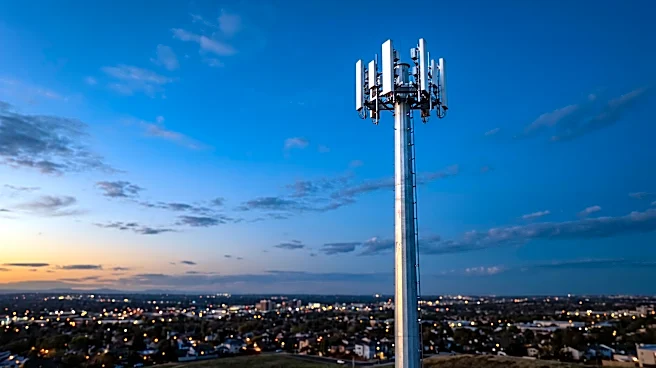
The U.S. telecom landscape is poised for continued evolution as traditional carriers, including Verizon, AT&T, and T-Mobile, have launched a joint venture to expand direct-to-device satellite connectivity. This collaboration aims to reduce U.S. coverage gaps by pooling investment and limited spectrum resources, while maintaining existing satellite partnerships. The joint venture will also focus on developing common technical specifications and integrating additional satellite providers. Meanwhile, SpaceX's mobile ambitions, backed by a spectrum deal with EchoStar, will continue to draw scrutiny and potentially challenge the market. The ongoing discussions around AI disruption and its potential to influence consumer behavior in seeking lower monthly bills will likely prompt telecom and cable companies to adapt their pricing structures and customer retention strategies. The market will closely watch how these competitive and technological pressures impact future valuations and strategic decisions within the sector.
Beyond the Headlines
The ongoing tension between established terrestrial network providers and emerging satellite-based services, as highlighted by AT&T CEO John Stankey's comments, points to a deeper strategic battle for the future of connectivity in the U.S. This isn't merely a technological competition but a fundamental disagreement on the most effective and scalable approach to nationwide coverage. The joint venture by major carriers to enhance satellite connectivity, even while questioning the viability of a purely satellite-driven model, suggests a hybrid approach may be the long-term solution. Furthermore, the increasing influence of AI agents in consumer decision-making could fundamentally alter customer loyalty and pricing power within the telecom industry. This shift could force carriers to innovate beyond network infrastructure, focusing more on personalized services and value propositions to retain subscribers. The ethical implications of AI-driven consumer choices and data privacy will also become increasingly relevant as these technologies mature.