
What's Happening?
The Pacific Maritime Association (PMA), representing employers at the Los Angeles and Long Beach seaports, and the International Longshore and Warehouse Union (ILWU) Local 26 have extended their bargaining
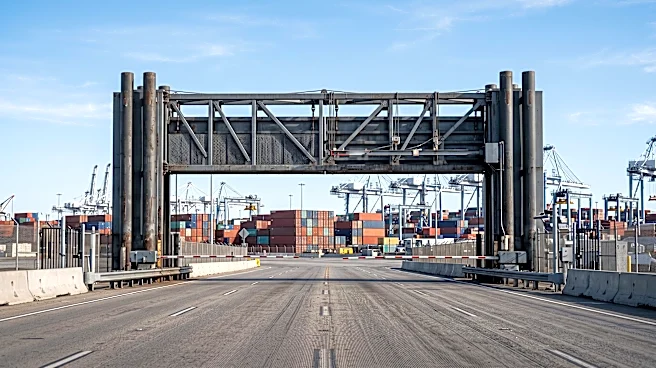
deadline until November 20. This extension averts a potential strike by approximately 250 maritime watchmen, who constitute about 2% of the workforce at the busiest U.S. container port complex. The watchmen are responsible for controlling and inspecting truck and employee entries at terminal gates, providing terminal security, and guarding and tracking critical cargo. Additional talks between the PMA and Local 26 are scheduled. A strike by this union would significantly disrupt operations, affecting terminals that handle roughly 85% of the cargo at Long Beach and 33% at Los Angeles. Both ports reported record-breaking cargo volumes for September, including retail goods for holiday sales, equipment for AI data center construction, and auto parts.
Why It's Important?
The extension of contract talks is crucial for maintaining the flow of goods through two of the nation's most vital port complexes. A strike, even by a small percentage of the workforce, could have cascading effects on the U.S. supply chain, particularly as the holiday shopping season approaches. The Los Angeles and Long Beach ports are critical gateways for international trade, handling a substantial portion of goods entering the country. Disruptions here could lead to delays, increased shipping costs, and potential shortages of consumer goods, impacting businesses and consumers nationwide. The continued operation of these ports is also essential for industries relying on imported components, such as the burgeoning AI data center construction sector and the automotive industry, which depend on timely deliveries to maintain production schedules.
What's Next?
The focus now shifts to the ongoing negotiations between the Pacific Maritime Association and ILWU Local 26, with a new deadline set for November 20. The outcome of these talks will determine whether a strike is ultimately avoided or if further disruptions to port operations will occur. Stakeholders, including retailers, manufacturers, and logistics companies, will be closely monitoring the progress of these negotiations. A successful resolution would ensure the continued smooth operation of the ports, supporting economic stability and preventing potential supply chain bottlenecks. Conversely, a failure to reach an agreement could trigger a strike, leading to significant economic repercussions and highlighting vulnerabilities in the nation's port infrastructure.
Beyond the Headlines
This situation underscores the critical role that port labor unions play in the U.S. economy and the delicate balance between labor rights and economic stability. The potential for a small group of workers to significantly impact national supply chains highlights the interconnectedness of modern commerce. It also brings to light the broader challenges of labor relations in essential industries, where disputes can have far-reaching consequences beyond the immediate parties involved. The reliance on these ports for a wide array of goods, from everyday consumer items to specialized industrial components, emphasizes the need for robust and resilient supply chain strategies to mitigate risks associated with potential labor actions or other disruptions.