


What's Happening?
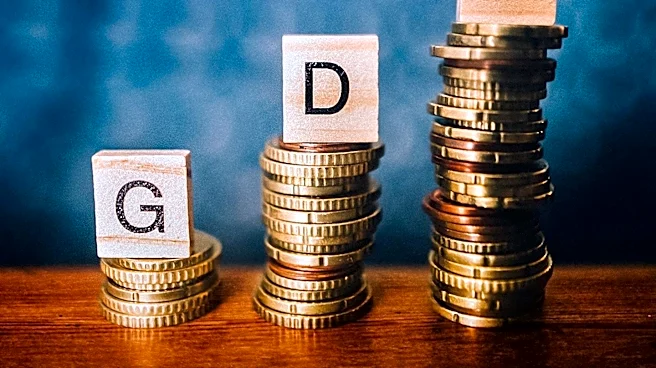
Moody's Ratings anticipates a slowdown in U.S. economic growth, projecting it to settle at 2% in both 2027 and 2028. This forecast follows a stronger-than-expected 3.4% annualized GDP growth rate in the third quarter, according to The Wall Street Journal.
For the entirety of 2026, Moody's expects a 2.3% growth rate. The ratings agency attributes the projected deceleration to several factors: higher interest rates, sustained elevated energy prices, and a normalization of the artificial intelligence (AI) investment cycle. Despite the anticipated slowdown, Moody's has maintained its stable outlook on the U.S. credit rating, citing the economy's inherent strengths and the U.S. dollar's role as the global reserve currency. The agency also assumes the Federal Reserve will maintain its independence and effective policy record.
Why It's Important?
The projected slowdown in U.S. economic growth has significant implications for various sectors, particularly for property owners and the broader business landscape. Higher interest rates, identified by Moody's as a key factor, directly impact borrowing costs, which are a critical variable for property owners and businesses seeking financing. A normalization of the AI investment cycle, while potentially leading to long-term productivity gains, suggests a tempering of the current boom in data center and AI infrastructure buildouts that are presently propping up GDP. This shift could affect technology companies and related industries. The stable outlook on the U.S. credit rating, however, underscores confidence in the nation's economic resilience and the dollar's global standing, which can help cushion against economic shocks and maintain investor confidence.
What's Next?
The trajectory of U.S. economic growth in the coming years will largely depend on the evolution of interest rates and energy prices. These two variables are expected to determine whether growth lands at the projected 2% or potentially lower. For property owners, monitoring borrowing costs will remain paramount, as these directly influence their financial viability and investment decisions. The Federal Reserve's monetary policy decisions will be crucial in shaping interest rate movements. Additionally, the long-term impact of AI investments on productivity remains an open question, and its eventual contribution to economic growth will be closely watched. The continued stability of the U.S. credit rating will also be a key indicator of the nation's economic health and its attractiveness to global investors.
Beyond the Headlines
The anticipated normalization of the AI investment cycle highlights a broader economic dynamic where emerging technologies often experience initial rapid growth followed by a more sustainable, albeit slower, integration into the economy. While AI buildouts are currently contributing to GDP, their long-term impact on productivity and the labor market will be a critical area of focus. The interplay between technological advancements, monetary policy, and global energy markets underscores the complex and interconnected nature of the modern U.S. economy. The reliance on the dollar as the global reserve currency provides a unique buffer for the U.S. economy, allowing it to absorb shocks that might more severely impact other nations. This status also implies a responsibility to maintain economic stability and sound fiscal policies.