





What's Happening?
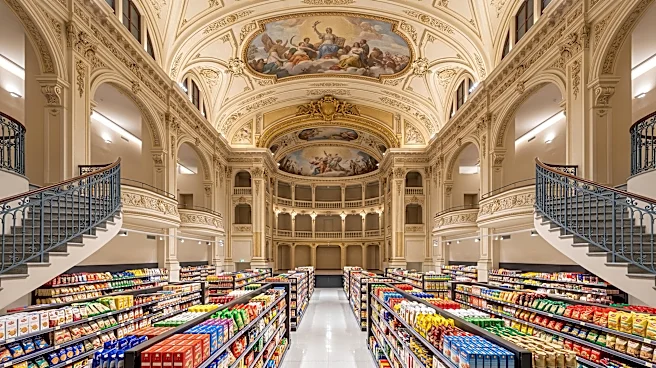
A supermarket in Venice, Despar Teatro Italia, has become a notable tourist attraction due to its unique location within a former Neo-Gothic and Art Nouveau theater. The store has preserved many of the original decorative details, including stucco work,
curved staircases, and an allegorical ceiling fresco dedicated to the Glory of Italy. This unusual setting, where supermarket shelves are stocked beneath historic art, has drawn attention from both locals and tourists. The phenomenon is part of a growing trend known as 'grocery store tourism,' where visitors explore supermarkets in other countries to observe local food habits, products, and the character of a city beyond its main sights. The conversion of the theater into a supermarket was initially controversial but has since become a popular stop, highlighting the repurposing of Venice's historic buildings for daily life.
Why It's Important?
The transformation of Despar Teatro Italia into a tourist destination underscores the evolving nature of tourism and the increasing interest in authentic, everyday experiences. This trend of 'grocery store tourism' offers a unique lens through which visitors can understand local culture and daily life, moving beyond conventional sightseeing. For Venice, a city grappling with over-tourism, such initiatives can help disperse visitors to less conventional locations and provide a different perspective on its rich history and urban fabric. Economically, it can generate unexpected revenue streams for businesses that creatively integrate historical preservation with modern commercial functions. It also highlights the potential for urban spaces to serve multiple purposes, blending heritage with contemporary needs, and offering a more nuanced understanding of a city's identity.
What's Next?
The success of Despar Teatro Italia could inspire other cities with rich historical architecture to explore similar adaptive reuse projects, transforming underutilized historic buildings into functional and appealing commercial spaces. This trend might lead to a broader acceptance and even encouragement of 'grocery store tourism' as a legitimate form of cultural exploration, potentially influencing how travel guides and tourism boards promote destinations. Future developments could include more businesses integrating historical elements into their modern operations, creating unique consumer experiences that blend shopping with cultural immersion. This approach could also foster greater community engagement with historical sites, making them more accessible and relevant to daily life rather than solely preserving them as static museums.
Beyond the Headlines
The phenomenon of Despar Teatro Italia touches upon deeper themes of urban development, historical preservation, and cultural identity. It challenges traditional notions of how historical sites should be used, demonstrating that active integration into daily life can be a powerful form of preservation. The initial controversy surrounding the theater's conversion highlights the tension between maintaining historical integrity and adapting to modern needs. However, its current popularity suggests a public appreciation for innovative solutions that make history tangible and accessible. This blending of the mundane (grocery shopping) with the magnificent (historic art) creates a unique cultural dialogue, inviting reflection on the layers of history embedded within urban landscapes and how they continue to shape contemporary experiences. It also subtly critiques the separation of art and daily life, suggesting that beauty and history can be found in unexpected, utilitarian spaces.