




What's Happening?
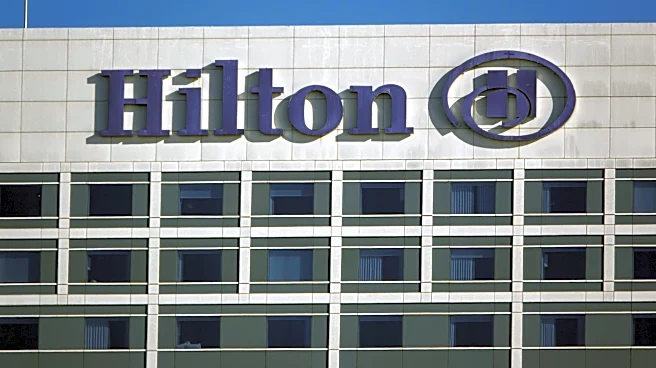
Hilton has announced robust financial performance for the first quarter of 2026, with system-wide Revenue Per Available Room (RevPAR) increasing by 3.6% year-over-year. Adjusted EBITDA rose by 13% to $901 million, and diluted Earnings Per Share (EPS)
reached $2.01, surpassing the high end of guidance. This strong showing was primarily driven by strengthening demand trends across all chain scales, brands, and segments, particularly in the U.S. where business transient, leisure transient, and group RevPAR all saw significant growth. The company also reported opening 131 hotels, adding over 16,000 rooms, marking its second strongest first quarter for hotel openings in its history. Despite headwinds from the Middle East conflict, Hilton has raised its full-year RevPAR growth guidance to 2%-3% and expects net unit growth of 6%-7%. The company returned over $860 million to shareholders in Q1 and is on track to return approximately $3.5 billion for the full year.
Why It's Important?
Hilton's positive Q1 2026 results and optimistic outlook signal a resilient and growing U.S. hospitality sector, which has broader implications for the national economy. The reported increase in business transient, leisure, and group travel indicates a healthy rebound in corporate activity, consumer confidence, and event-driven demand. This trend is crucial for job creation in the service industry, local economies benefiting from tourism, and related sectors like transportation and entertainment. The company's continued expansion, particularly in luxury and lifestyle brands, reflects confidence in sustained market demand and offers diverse options for travelers. Furthermore, Hilton's strategic focus on technology and AI, including the launch of the Hilton AI Planner, highlights a broader industry shift towards leveraging innovation to enhance customer experience and operational efficiency. The commitment to returning capital to shareholders also suggests financial stability and attractiveness for investors, potentially influencing investment trends within the hospitality and real estate sectors.
What's Next?
Hilton anticipates continued strong performance throughout 2026, with full-year RevPAR growth projected between 2%-3%. The company expects U.S. RevPAR growth to be at the higher end of this guidance, driven by ongoing momentum in business and leisure travel. While the Middle East conflict is expected to cause some headwinds, particularly in Q2, Hilton believes its diversified global portfolio and strong development pipeline will mitigate these impacts. The company plans to continue its aggressive expansion, with a record pipeline of 527,000 rooms and significant growth opportunities in emerging markets like India and Southeast Asia. Hilton will also further integrate AI and technology into its operations and customer experience, with initiatives like the Hilton AI Planner aiming to drive incremental demand and enhance guest journeys. Investors can expect continued capital returns, with approximately $3.5 billion projected for the full year through buybacks and dividends, signaling ongoing confidence in the company's financial health and future prospects.
Beyond the Headlines
Hilton's emphasis on a 'C-shaped economy' in the U.S., characterized by improving performance in lower and mid-chain scales, suggests a significant shift in economic dynamics. This trend, attributed to supportive tax and regulatory policies, anticipated lower interest rates, and increased private sector investment in AI and infrastructure, points to a broader distribution of economic benefits to middle and lower-income consumers. This could lead to a more inclusive economic recovery, impacting consumer spending patterns and the types of hospitality services in demand. The company's aggressive adoption of AI, including partnerships with Google, ChatGPT, and Anthropic, underscores the transformative potential of artificial intelligence across industries. This technological integration is not merely about efficiency but also about fundamentally reshaping customer engagement and service delivery, raising questions about the future of human-centric hospitality and the ethical implications of AI in personalized services. The ongoing geopolitical uncertainties, particularly in the Middle East, highlight the vulnerability of global businesses to regional conflicts, necessitating adaptable strategies and diversified market presence.