





What's Happening?
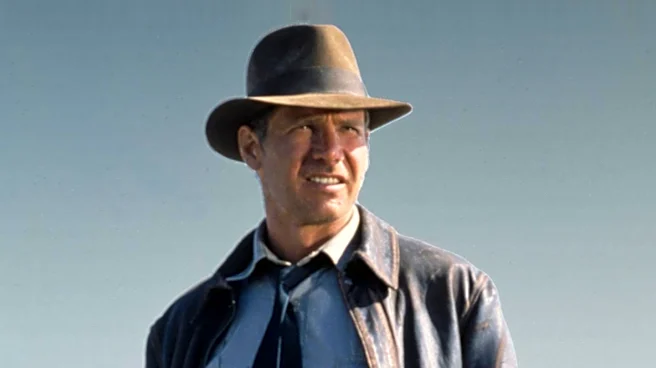
The film 'The Mosquito Coast,' starring Harrison Ford, is being re-examined 40 years after its release. The movie features Ford as Allie Fox, a self-styled intellectual who moves his family to the remote jungles of Honduras to build a utopian society.
Fox, a Harvard dropout, believes he understands the world better than anyone else and is critical of modern society. The role was initially offered to Jack Nicholson, who declined due to a fee dispute. Director Peter Weir, who previously worked with Ford on 'Witness,' cast him in the challenging role, which aimed to subvert Ford's established heroic image. The film portrays Fox's descent from a visionary inventor to a tyrannical figure, ultimately leading to destructive outcomes for his family and himself. Despite Ford's commitment to the role, the film was not a commercial success and did not receive Oscar nominations, unlike his previous collaboration with Weir.
Why It's Important?
The re-evaluation of 'The Mosquito Coast' highlights a significant moment in Harrison Ford's career where he intentionally chose a role that challenged his public persona as a heroic lead. This decision demonstrated his willingness to take artistic risks, moving beyond the action-hero archetype he had cultivated with roles like Indiana Jones and Han Solo. The film's commercial failure and lack of critical acclaim at the time underscore the difficulties actors face when attempting to redefine their image, especially when audiences have strong expectations. For film enthusiasts and critics, revisiting 'The Mosquito Coast' offers insight into Ford's range as an actor and the complexities of a film that was perhaps ahead of its time in its critique of American exceptionalism and utopian ideals. It also serves as a case study in how a star's established image can influence a film's reception, regardless of the performance.
What's Next?
While 'The Mosquito Coast' is available for digital rental or purchase, its renewed discussion may lead to increased viewership among those interested in Harrison Ford's filmography or in films that explore themes of idealism and its pitfalls. This re-examination could also spark further critical analysis of other films where established actors took on unconventional roles, prompting a broader conversation about career choices and artistic integrity in Hollywood. For Ford, who has continued to take on diverse roles throughout his career, this retrospective look at 'The Mosquito Coast' reinforces his reputation as an actor willing to push boundaries, even if the immediate results were not commercially successful. The film's themes of environmentalism, anti-consumerism, and the dangers of unchecked ambition remain relevant, potentially drawing new audiences to its narrative.
Beyond the Headlines
Beyond its immediate narrative, 'The Mosquito Coast' delves into deeper implications concerning the American psyche and the pursuit of utopian ideals. Allie Fox's character embodies a critique of modern industrial society and a desire to return to a more 'pure' existence, yet his methods quickly devolve into a form of colonialism and tyranny. This reflects a darker side of American individualism and the potential for self-righteousness to lead to destructive outcomes. The film subtly explores themes of cultural insensitivity and the imposition of Western ideals on indigenous populations, as Fox commands local laborers while simultaneously rejecting aspects of his own culture. The movie's initial commercial failure might also suggest a societal discomfort with such a critical self-reflection during the 1980s, a period often associated with optimism and consumerism. Its enduring relevance lies in its complex portrayal of a man driven by conviction, whose vision ultimately consumes him and those around him.