





What's Happening?
Woodside Energy's Trion deepwater oil project in Mexico is 71% complete and remains on budget, with the company targeting first oil production in 2028. This information comes from Woodside's Capital Markets Day 2026 presentation. The Trion project is designed
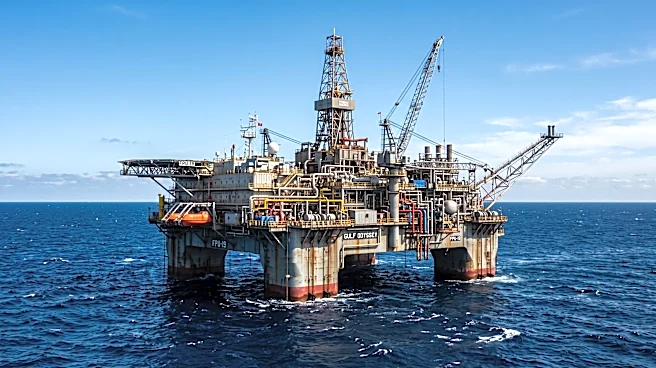
to produce 100,000 barrels per day and is expected to diversify Woodside's cash flow, contributing approximately $1.1 billion annually in adjusted operating cash flow between 2028 and 2032 (Woodside's share). Located in the Perdido Fold Belt of the Gulf of Mexico, about 180 km off the Mexican coastline and 30 km south of the US-Mexico maritime border, the project operates in water depths of around 2,500 meters. Woodside holds a 60% interest as the operator, while Mexico's state oil company Pemex holds the remaining 40%. The final investment decision for Trion, Mexico's first deepwater oil development, was made in 2023. As of the third quarter of 2026, 10 of the 24 planned wells have been drilled, and the first subsea tree has been installed. Fabrication of the floating production unit (FPU) Tláloc is 96% complete, with integration and pre-commissioning in progress. Production will be supported by a floating storage and offloading vessel (FSO) with a capacity of 950,000 barrels. The project is projected to generate over $10 billion in taxes and royalties for Mexico over its lifespan. The Trion field, discovered by Pemex in 2012, holds 3P reserves of approximately 305 million barrels of oil equivalent.
Why It's Important?
The Trion deepwater oil project holds significant importance for both Mexico and the broader North American energy landscape. For Mexico, it represents the nation's first deepwater oil development, potentially unlocking substantial new revenue streams through taxes and royalties, estimated at over $10 billion over the project's life. This influx of funds could support national development initiatives and strengthen the country's economic stability. For the U.S., the project's proximity to the US-Mexico maritime border in the Gulf of Mexico means increased oil production in the region, which could contribute to overall North American energy security and supply diversification. As geopolitical instabilities in other oil-producing regions continue to impact global markets, a stable and growing supply from a neighboring country like Mexico could help mitigate price volatility and ensure more reliable access to crude oil for U.S. refineries. The involvement of Woodside Energy, a major international player, also signifies continued foreign investment in Mexico's energy sector, potentially fostering technological transfer and job creation. The project's successful completion could also set a precedent for future deepwater developments in the Gulf, further solidifying the region's role as a key global energy producer.
What's Next?
With the Trion project 71% complete and targeting first oil in 2028, the immediate next steps involve the continued drilling of the remaining wells and the final integration and pre-commissioning of the floating production unit (FPU) Tláloc. The installation of additional subsea infrastructure will also be crucial. As the project moves closer to its production phase, Woodside Energy and Pemex will focus on operational readiness, including staffing, logistics, and ensuring compliance with environmental and safety regulations for deepwater operations. The successful commencement of production in 2028 will be a critical milestone, after which the focus will shift to optimizing output and managing the long-term production profile of the field. The project's progress will likely be closely monitored by other international energy companies and investors, as its success could influence future investment decisions in Mexico's deepwater sector. Furthermore, the revenue generated from Trion will begin to impact Mexico's national budget and economic planning from 2028 onwards, potentially leading to new government spending or investment strategies.
Beyond the Headlines
The Trion project's development highlights several deeper implications beyond its immediate economic impact. As Mexico's first deepwater oil development, it signifies a strategic shift for Pemex and the country's energy policy, moving into more technologically complex and capital-intensive offshore exploration and production. This could lead to a greater emphasis on specialized skills and infrastructure within Mexico's energy sector. Environmentally, deepwater drilling carries inherent risks, and the project's operation will be under scrutiny regarding its adherence to stringent safety and environmental protection standards, especially given its location in the Gulf of Mexico, an ecologically sensitive area. The long-term success of Trion could also influence the balance of power within Mexico's energy industry, potentially strengthening Pemex's financial position and its role in national energy security. Moreover, the collaboration between an international operator like Woodside and a state-owned entity like Pemex could serve as a model for future public-private partnerships in complex energy projects, impacting how Mexico leverages foreign expertise and investment while maintaining national control over its natural resources.