





What's Happening?
SoftBank Group, a Japanese technology conglomerate, has initiated a bond sale exceeding $11 billion. This significant financial maneuver is intended to fund a $10 billion payment for the third tranche of its follow-on investment in OpenAI, with the transaction
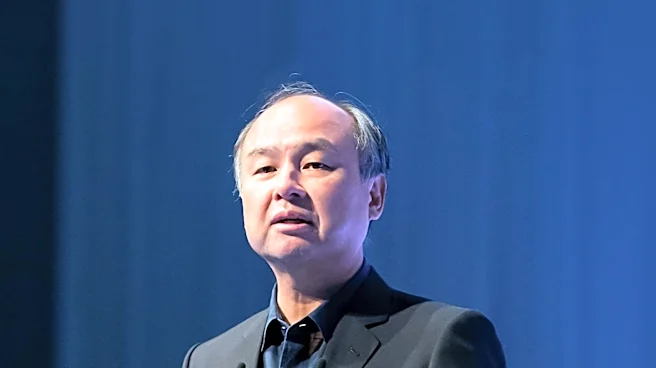
expected to finalize on October 1. The bond offering includes $10 billion in dollar-denominated notes across 3.5-year, 5.5-year, and 7.5-year maturities, alongside €1 billion (approximately $1.15 billion) in euro-denominated bonds with four-year and six-year maturities. If successfully completed at its projected size, this bond deal would represent the largest non-financial corporate bond issuance on record in the Asia-Pacific region, surpassing 7-Eleven's $10.93 billion sale in January 2021. Additionally, it would rank among the top 20 largest corporate bond deals globally for the current year, according to Dealogic data. The proceeds from this bond sale will also be used to cancel a $10 billion bridge loan facility that SoftBank had previously secured for the same investment purpose. SoftBank, under the leadership of billionaire Masayoshi Son, has committed nearly $65 billion to OpenAI in total.
Why It's Important?
This substantial bond issuance by SoftBank to fund its investment in OpenAI underscores the escalating global interest and financial commitment towards artificial intelligence. For the U.S. technology sector, particularly AI companies like OpenAI, such large-scale foreign investment signifies robust confidence in their growth potential and technological advancements. It provides a significant capital injection that can accelerate research, development, and market expansion for OpenAI, potentially solidifying its position as a leader in the AI landscape. The scale of this bond deal also highlights the increasing financial interconnectedness of global markets, where capital from Asia-Pacific is directly fueling innovation in U.S. tech. This influx of capital could lead to intensified competition and innovation within the AI industry, benefiting consumers and businesses through more advanced AI applications. Conversely, it also raises questions about the influence of foreign investment on critical U.S. technological infrastructure and the potential for shifts in market dynamics as major global players deepen their stakes in key sectors.
What's Next?
The bond sale is currently in the investor interest gauging phase, with final terms subject to change. Upon successful completion, the $10 billion payment to OpenAI for its third investment tranche is anticipated to close on October 1. This capital infusion will likely enable OpenAI to further its ambitious projects, potentially leading to new product announcements, expanded research initiatives, or strategic partnerships. The cancellation of the $10 billion bridge loan facility will streamline SoftBank's financial structure related to this investment. Market observers will be closely watching the pricing levels and overall reception of the bond offering, as its success could influence future large-scale corporate debt issuances, particularly those aimed at funding high-growth technology investments. The continued flow of significant capital into AI companies like OpenAI suggests an ongoing period of rapid development and commercialization in the artificial intelligence sector, with potential implications for various industries reliant on AI technologies.
Beyond the Headlines
SoftBank's massive investment in OpenAI, facilitated by this bond sale, reflects a broader trend of technology conglomerates betting heavily on the future of artificial intelligence. This move is not merely a financial transaction but a strategic alignment with what many consider the next frontier of technological innovation. The ethical and societal implications of such concentrated investment in AI are profound. As AI capabilities advance rapidly, questions surrounding data privacy, algorithmic bias, job displacement, and the responsible development of powerful AI systems become increasingly critical. The substantial capital flowing into OpenAI could accelerate the development of AI that has far-reaching impacts on daily life, from automated services to advanced decision-making systems. This also highlights the growing influence of a few dominant players in shaping the trajectory of AI, potentially leading to a concentration of power and control over future technologies. The long-term shifts triggered by such investments could redefine economic structures, labor markets, and even geopolitical dynamics, making the governance and ethical oversight of AI development paramount.