







What's Happening?
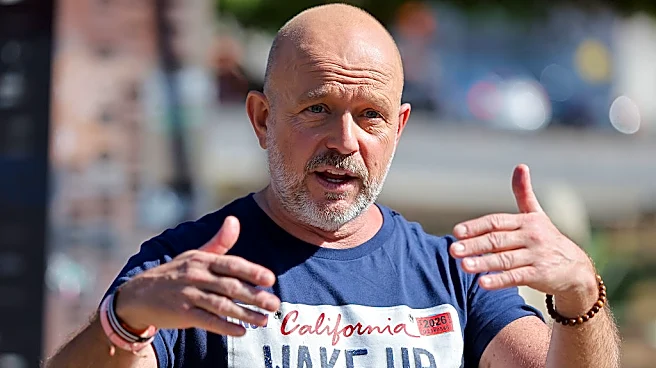
Robin Wright is featured in the film 'Here,' which utilizes advanced AI technology developed by BRAHMA AI, a company founded by Flemish entrepreneur Jo Plaete. This technology, which recently won a Technology & Engineering Emmy Award, allows for 'AI-Based
Face Replacement and Performance-Preserving Post-Production Transformation.' Specifically, it can alter an actor's age, making a 70-year-old appear in their twenties, or even bring deceased actors back to life for sequels. In 'Here,' this technology is used to depict various life stages of the lead actors, including Robin Wright and Tom Hanks, while maintaining their original performance, expressions, and timing. The technology also enables dubbing films into different languages while preserving the actor's original voice, facial expressions, and articulation, making it appear as though the film was originally made in the new language.
Why It's Important?
This AI technology represents a significant advancement in the film industry, potentially revolutionizing how films are produced and distributed. For actors like Robin Wright, it means their performances can be adapted across different age ranges or even languages without requiring reshoots or losing the authenticity of their original acting. This could extend an actor's career longevity and expand their global reach. The ability to seamlessly change an actor's age or language could also open new creative avenues for filmmakers, allowing for more complex narratives and character developments. Furthermore, the technology's capacity to dub films while retaining original vocal nuances and facial expressions could break down language barriers in cinema, enabling films from smaller markets to reach a global audience more effectively, as highlighted by the potential for Flemish films to conquer the American market.
What's Next?
BRAHMA AI is actively in discussions with major film studios and distributors to implement this technology on a larger scale. A significant milestone will be the upcoming release of a major Indian film, 'Ramayana,' in the United States, which has been fully translated into English using this AI, while preserving the original actors' voices and facial expressions. This release will serve as a key demonstration of the technology's capabilities and its potential impact on international film distribution. The continued adoption of such AI in Hollywood and global cinema could lead to new production workflows, casting considerations, and audience experiences, potentially setting a new standard for visual effects and localization in the entertainment industry.
Beyond the Headlines
The ethical and artistic implications of this AI technology are profound. While it offers unprecedented creative freedom and efficiency, questions may arise regarding the authenticity of performances, the potential for 'digital immortality' of actors, and the impact on traditional acting roles. The ability to digitally alter an actor's appearance or voice raises discussions about consent, intellectual property, and the definition of a 'performance.' As this technology becomes more widespread, it could lead to new legal frameworks and industry standards to address these complex issues. Moreover, the seamless integration of AI in film production could redefine the roles of actors, directors, and visual effects artists, fostering a new era of collaborative storytelling where technology and human creativity intertwine in novel ways.