





What's Happening?
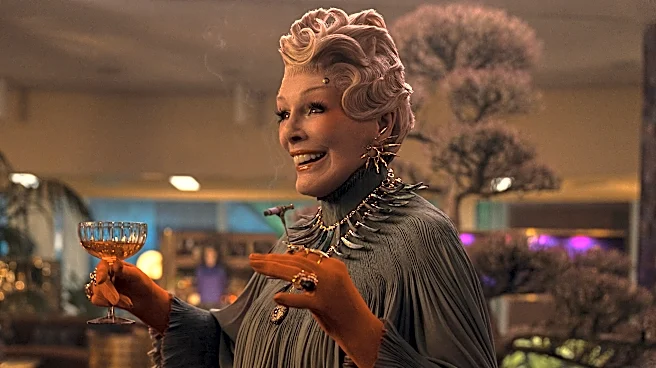
Actress Glenn Close has undergone a significant physical transformation for her role as Drusilla in the upcoming film 'The Hunger Games: Sunrise on the Reaping.' Close portrays the Capitol escort responsible for overseeing District 12's tributes, the children
selected to participate in the arena. Her character belongs to Panem's ruling class, where the Games serve as both a spectacle and a tool of state control. The film is set 24 years before the first 'Hunger Games' movie and follows 16-year-old Haymitch Abernathy as he enters the 50th Games. Close's portrayal of Drusilla features a taut face, protruding teeth—an idea she contributed—and a severe ginger wig, making her almost unrecognizable. She reportedly spent considerable time contorting her face to achieve the desired sinister look. Additionally, Close requested that her character be wheeled into her first scene on an upright stretcher, explaining her concept that Drusilla is so 'pulled in, she can’t breathe.'
Why It's Important?
Glenn Close's commitment to physically embodying her character highlights a significant aspect of method acting and character development in major film productions. Her detailed approach to Drusilla, from facial contortions to specific scene requests, underscores how actors can shape the visual and thematic elements of a film. This transformation is crucial for establishing Drusilla as a memorable antagonist within 'The Hunger Games' universe, a franchise known for its dystopian themes and complex characters. The physical choices made by Close contribute to the film's ability to convey the grotesque artifice and oppressive nature of the Capitol, making the villain unsettlingly present rather than merely likable. This level of dedication can elevate the audience's immersion and understanding of the film's narrative, reinforcing the themes of control and spectacle inherent in the story.
What's Next?
'The Hunger Games: Sunrise on the Reaping' is scheduled to be released in cinemas on November 20. Following its release, audiences will have the opportunity to witness Glenn Close's transformative performance as Drusilla. The film's reception will likely be influenced by how effectively Close's portrayal contributes to the overall narrative and the established lore of 'The Hunger Games.' Critical and audience reactions will determine the impact of her character on the franchise's legacy. Discussions are anticipated regarding the effectiveness of her physical transformation and how Drusilla compares to other iconic villains in cinema, particularly given Close's history of playing complex antagonists. The film's success could also influence future casting decisions for roles requiring significant character transformations.
Beyond the Headlines
Glenn Close's approach to Drusilla extends beyond mere costume and makeup; it delves into the psychological and physical manifestations of a character deeply entrenched in a corrupt system. Her choice to distort Drusilla's appearance reflects a deeper commentary on how individuals within oppressive regimes can become physically and emotionally warped by their environment and roles. This transformation can be seen as an extension of her character's commitment to the Capitol's artifice, where even the body becomes a tool of control and spectacle. Close's history of playing complex female antagonists, such as Cruella de Vil and Alex Forrest, suggests a recurring interest in exploring women who defy societal expectations and embrace their darker sides. This performance in 'The Hunger Games' continues that thematic exploration, offering a nuanced portrayal of villainy that challenges audiences to consider the origins and implications of such monstrous characters.