





What's Happening?
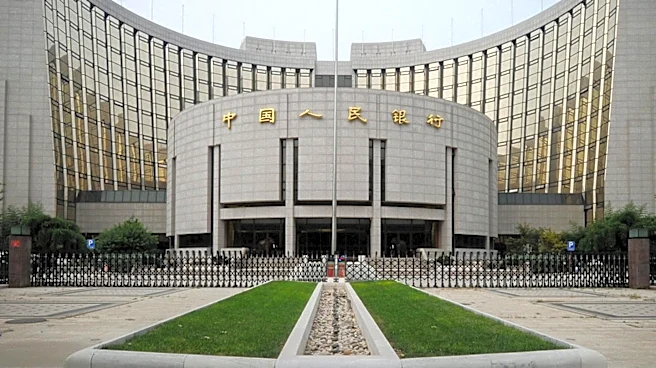
The Industrial and Commercial Bank of China (ICBC) is planning to raise approximately $15 billion (100 billion yuan) through a private placement of shares. This capital injection is intended to replenish ICBC's core Tier 1 capital, which is crucial for
a bank's ability to absorb losses and maintain operations. The shares are expected to be purchased by China's Ministry of Finance, China National Tobacco Corporation, and related entities. While the capital is not directly earmarked for Standard Bank or African projects, it is significant due to ICBC's position as the largest shareholder in Standard Bank Group, Africa's largest lender by assets, holding 19.7% of its shares. This move is part of a larger recapitalization effort within China's financial sector, with ICBC and Agricultural Bank of China announcing combined capital-raising plans of about $39 billion, and a wider state program potentially reaching $53.6 billion for banks and insurers.
Why It's Important?
This substantial capital boost for ICBC, a major global financial institution, has significant implications for the U.S. and global financial landscape, particularly concerning China's expanding economic influence. While the funds are not directly for African projects, a stronger ICBC balance sheet indirectly supports its extensive partnership with Standard Bank, which connects Chinese businesses with African markets. This partnership facilitates trade, infrastructure financing, and yuan-clearing services across 19 African markets, offering a more direct route for transactions in China's currency. For the U.S., this development highlights China's strategic efforts to bolster its financial institutions and extend its economic reach, potentially impacting global trade dynamics and financial competition. A more robust ICBC could further enable China's Belt and Road Initiative and other international investment endeavors, influencing global supply chains and economic alliances. The recapitalization also reflects China's proactive measures to stabilize its financial system amidst low interest rates, slower economic growth, and weak credit demand, aiming to ensure continued business financing while safeguarding against losses.
What's Next?
The capital injection is expected to strengthen ICBC's financial resilience, potentially enabling it to expand its lending capacity and international operations. While not directly allocated to Africa, a stronger ICBC could indirectly support increased trade finance, infrastructure lending, and yuan-denominated transactions through its partnership with Standard Bank. This could further entrench the use of the Chinese yuan in African markets, potentially challenging the dominance of other currencies in regional trade. The broader Chinese financial-sector recapitalization program suggests a sustained effort by Beijing to fortify its banking system, which could lead to increased global financial activity from Chinese institutions. U.S. policymakers and businesses will likely monitor these developments to assess their impact on international trade, investment flows, and geopolitical competition, particularly in regions where both the U.S. and China have strategic interests.
Beyond the Headlines
This capital infusion for ICBC goes beyond a simple financial transaction; it represents a strategic move by the Chinese government to reinforce its financial infrastructure and project its economic power globally. By strengthening its largest banks, China aims to enhance its capacity to finance international trade and investment, particularly in emerging markets like Africa. This strategy has long-term implications for the global financial order, potentially accelerating the internationalization of the yuan and creating alternative financial pathways that bypass traditional Western-dominated systems. For the U.S., this signifies a continued shift in global economic power dynamics, where China is actively building a financial ecosystem to support its geopolitical and economic ambitions. The increased financial integration between China and Africa, facilitated by institutions like ICBC and Standard Bank, could lead to deeper economic ties and influence, potentially reshaping trade patterns and diplomatic relations on a global scale.