




What's Happening?
AMD has announced the acquisition of World Labs, a spatial AI research firm, in an all-stock deal valued at approximately $8.2 billion. This acquisition is part of a broader strategic update from AMD, which also includes the launch of its 6th Gen EPYC
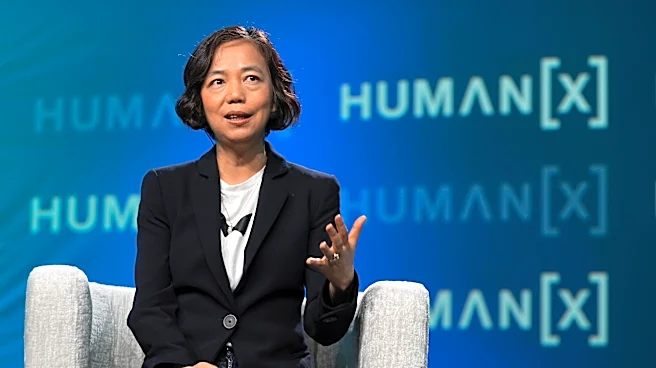
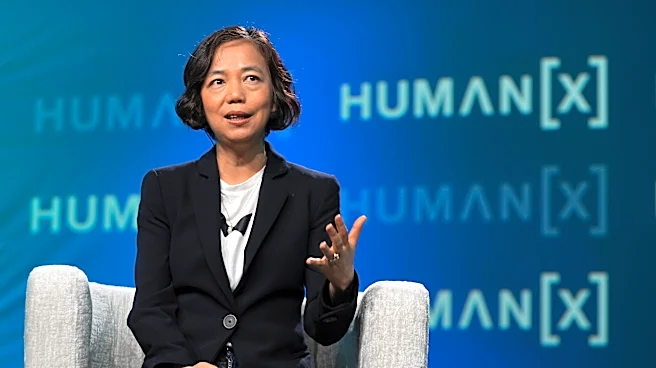
“Venice” processors, the introduction of Helion (an open rack blueprint for agentic AI), and the Ryzen AI Halo developer platform. Dr. Fei-Fei Li, a prominent figure in AI research, is set to join AMD as Executive Vice President and Chief Scientist upon the closing of the World Labs acquisition. The move signifies AMD's intent to deepen its involvement in the agentic AI stack, moving beyond just hardware to encompass software and infrastructure for autonomous AI workloads. The EPYC Venice processors are already shipping for enterprise, AI agent, and GPU host workloads, with confirmed deployments at Microsoft Azure and Oracle Cloud.
Why It's Important?
This acquisition is crucial for AMD as it aims to differentiate itself in the highly competitive AI market. By integrating World Labs' spatial AI capabilities, AMD seeks to offer unique features that other x86 vendors may not match, particularly as AI agents evolve from text generation to interacting with the physical world. The addition of Dr. Fei-Fei Li also brings significant talent and credibility to AMD's AI research efforts. For the broader AI industry, this signals a growing trend of hardware manufacturers investing heavily in specialized AI software and research to create more comprehensive solutions. The success of this integration could position AMD as a leader in infrastructure for autonomous AI, impacting cloud providers, enterprises, and developers who rely on advanced AI capabilities.
What's Next?
The immediate focus will be on the integration of World Labs' research team and spatial AI capabilities into AMD's existing inference hardware roadmap. Industry observers will be closely watching AMD's post-close earnings calls for concrete product roadmap commitments tied to World Labs technology. AMD also needs to ensure its software ecosystem, particularly ROCm, achieves feature parity with competitors like NVIDIA's CUDA for common agentic frameworks within the next two release cycles. This is critical for attracting and retaining developers, as developer velocity and ease of integration are significant factors in platform adoption. Furthermore, AMD's software stack will need to navigate compliance hurdles in U.S. federal environments to translate hardware wins into full-stack government deployments.
Beyond the Headlines
The acquisition of World Labs highlights a strategic shift in the AI landscape, where the value proposition extends beyond raw processing power to include sophisticated perception and reasoning capabilities. This move by AMD underscores the increasing importance of spatial intelligence in the development of advanced AI agents that can understand and interact with 3D environments. It also reflects a broader industry trend where companies are seeking to own more of the AI stack, from silicon to software, to create integrated and differentiated solutions. The success of this strategy could influence future mergers and acquisitions in the AI sector, as companies vie for specialized expertise and intellectual property in emerging AI domains like spatial computing and agentic AI.