







What's Happening?
Ontario Power Generation (OPG) has confirmed that its first GE Vernova Hitachi BWRX-300 small modular reactor (SMR) at Darlington will exceed its approved budget of C$7.7 billion and will not meet its October 2030 commercial operation target. While a new
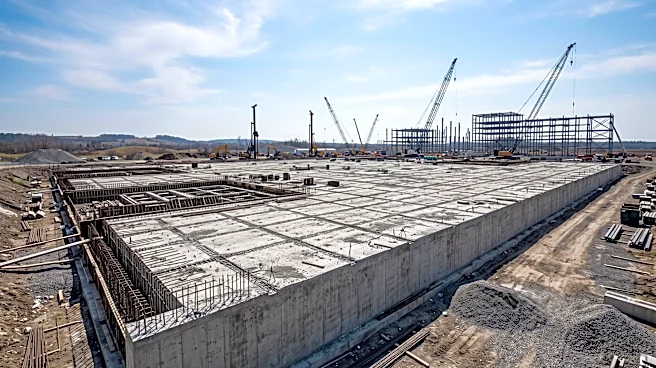
cost estimate or completion date has not yet been provided, OPG anticipates completing its engineering, cost, and schedule review by mid-2027. The primary reason cited for these issues is ongoing first-of-a-kind reactor engineering, which has impacted construction execution and supply-chain performance. Physical work commenced before certain design aspects were finalized, leading to disruptive changes during construction. Despite progress on the reactor foundation, turbine building, and cooling-water tunnel equipment, the project faces challenges related to engineering dependencies, supplier requirements, and the delivery sequence for a novel reactor design. Consequently, OPG has withdrawn the Darlington SMR generation forecast from its 2027–2031 rate application to the Ontario Energy Board, indicating that previously planned electricity production for 2030 and 2031 is no longer expected.
Why It's Important?
The cost overruns and schedule delays at the Darlington SMR project have significant implications for Ontario's energy strategy and the broader SMR industry. Ontario has a four-reactor plan, and the financial viability of the subsequent reactors heavily relies on the first unit providing valuable learning and cost efficiencies. If the initial project struggles with escalating costs and delays, it undermines the economic case for future SMR deployments, potentially increasing electricity costs for consumers and businesses in Ontario. This situation also casts a shadow on the promise of SMR technology as a reliably cheap and timely source of future energy, especially given Ontario's favorable conditions for nuclear development, including an experienced workforce and established infrastructure. The challenges highlight the inherent risks associated with first-of-a-kind nuclear construction projects, where design maturity and construction sequencing are critical for success. The uncertainty could lead Ontario to re-evaluate its energy portfolio, potentially increasing reliance on other sources like wind and solar, which have recently secured new contracts at competitive prices.
What's Next?
Ontario Power Generation (OPG) is expected to complete its comprehensive engineering, cost, and schedule review for the Darlington SMR project by mid-2027. This review will provide updated estimates for the project's budget and commercial operation date. Before committing to the subsequent three reactors in its four-reactor program, Ontario is advised to require a credible, independent assessment of the first unit's revised cost and schedule. This assessment should include disclosure of outstanding design packages, evidence of construction learning, and a system-level comparison against alternative energy resources that can be delivered within the same timeframe. The Independent Electricity System Operator (IESO) will continue to assemble a reliable energy portfolio from new wind and solar contracts, existing nuclear and hydroelectric generation, storage, and flexible demand, as the SMR project's timeline remains uncertain. The focus will be on ensuring the whole-system cost-effectiveness of Ontario's energy supply.
Beyond the Headlines
The Darlington SMR project's challenges underscore a fundamental tension in large-scale infrastructure development, particularly in the nuclear sector: the balance between innovation and execution risk. The 'think slow, act fast' approach, advocating for mature engineering before commencing construction, appears to have been compromised, leading to the current difficulties. This situation highlights the broader issue of optimism bias in megaprojects, where initial cost and schedule estimates often prove overly ambitious. For the SMR industry globally, the Darlington experience serves as a critical case study, influencing investor confidence and regulatory scrutiny. It emphasizes that even with advanced technology and experienced operators, the transition from design to commercial operation for novel nuclear reactors is fraught with complexities. The long-term implications could include a more cautious approach to SMR deployment worldwide, increased demand for robust project management and risk assessment methodologies, and a potential shift in investment towards more proven renewable energy technologies if SMRs fail to deliver on their cost and schedule promises.