






What's Happening?
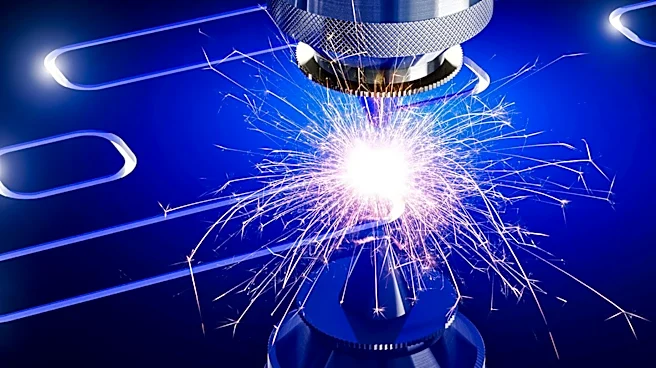
Electrical Discharge Machining (EDM) is a non-contact manufacturing process that removes material from a workpiece using controlled electrical sparks. This method is particularly effective for materials that are too hard or geometries that are too fine
for traditional cutting tools. The process involves submerging both an electrode (the tool) and the workpiece in a dielectric fluid. Rapid electrical pulses jump across a small gap between them, generating intense, localized heat that melts and vaporizes microscopic amounts of material. The dielectric fluid then flushes away the eroded debris and helps regulate the process. This cycle, repeated thousands of times per second, cumulatively erodes the material into the desired shape. EDM is crucial for applications where conventional machining methods would lead to rapid tool wear, poor tolerances, or physical access constraints, such as cutting intricate outlines, narrow deep slots, or complex 3D cavities in hardened tool steel or titanium components.
Why It's Important?
EDM's ability to machine electrically conductive materials regardless of their hardness is a significant advantage for U.S. industries, particularly in mold and die manufacturing, aerospace, and medical device production. It allows for the creation of components with extreme precision and intricate geometries that are otherwise impossible to achieve with traditional methods. For instance, in mold and die work, EDM enables the precise shaping of hardened tool steel cavities, which is critical for producing high-quality injection molds and stamping dies. In aerospace, it's used for creating cooling holes in turbine blades and machining superalloys. The medical device sector benefits from micro-EDM for fine, precise geometry in surgical instruments and implants. This technology reduces tool wear, minimizes mechanical stress on delicate parts, and ensures high accuracy, leading to more durable and reliable products across these critical sectors. While generally slower and more expensive per part than conventional machining, EDM's unique capabilities make it indispensable for specific, high-value applications.
What's Next?
The continued integration of EDM with other advanced manufacturing techniques, such as 3-, 4-, and 5-axis CNC machining, is expected to further enhance its capabilities and applications. This hybrid approach allows for the conventional machining of larger components, with EDM reserved for the intricate details and hardened sections that traditional tools cannot handle. Research and development will likely focus on improving EDM's material removal rates, surface finish quality, and reducing electrode wear to make the process more efficient and cost-effective. Additionally, advancements in dielectric fluids and control systems could lead to even greater precision and consistency. The aerospace and medical industries, with their stringent requirements for precision and material integrity, will continue to drive innovation in EDM technology, pushing for solutions that can handle increasingly complex designs and advanced materials.
Beyond the Headlines
The widespread adoption of EDM technology highlights a broader shift in manufacturing towards processes that prioritize precision and material integrity over sheer speed, especially for high-performance components. This reflects an increasing demand for specialized parts in critical industries where failure is not an option. The reliance on EDM also underscores the limitations of traditional subtractive manufacturing methods when dealing with modern, advanced materials that are designed for extreme hardness and durability. Furthermore, the process's ability to remove broken taps or drill bits from expensive parts without damaging the surrounding material has significant economic implications, preventing costly scrap and rework. This technological evolution suggests a future where manufacturing processes are increasingly tailored to specific material properties and geometric complexities, moving away from a 'one-size-fits-all' approach and fostering greater innovation in product design and functionality.