






What's Happening?
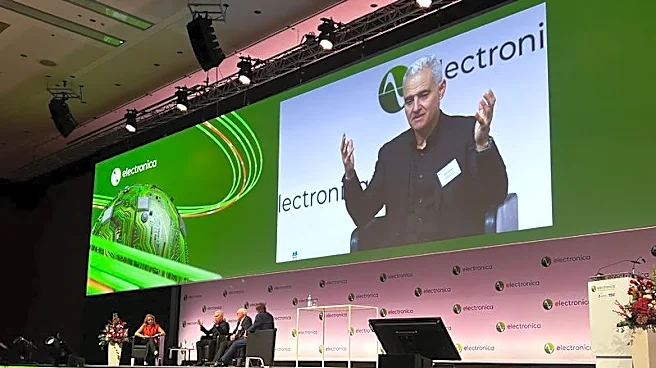
Elmos Semiconductor SE, in collaboration with Chinese robotics company AGIBOT, is showcasing applications of Elmos's integrated circuits (ICs) in humanoid robots at Electronica 2026 in Munich. This marks the first time Elmos is presenting its technologies
for robotics, leveraging its extensive automotive expertise. Humanoid robots, being complex, autonomous, and battery-powered systems, share architectural similarities with modern vehicles, particularly in their reliance on computers, sensors, and actuators. Elmos is demonstrating how its proven semiconductor solutions for sensing, motor control, communication, and power supply, originally developed for the automotive industry, can be effectively applied to humanoid robotics. Visitors to Electronica 2026 can observe an AGIBOT humanoid robot in action, illustrating the practical integration of these technologies.
Why It's Important?
The collaboration between Elmos Semiconductor SE and AGIBOT highlights a significant trend in technological convergence, where innovations from one industry, such as automotive, are being adapted to drive advancements in another, like robotics. This cross-industry application of semiconductor solutions is crucial for accelerating the development and commercialization of humanoid robots. By utilizing proven automotive-grade ICs, robotics manufacturers can benefit from established reliability, efficiency, and cost-effectiveness, potentially reducing development cycles and improving robot performance. This synergy opens up a new long-term growth area for semiconductor companies like Elmos and provides robotics companies with robust, high-performance components, ultimately contributing to the broader adoption of humanoid robots in various sectors.
What's Next?
Elmos Semiconductor SE anticipates that humanoid robotics will become a substantial long-term market, leading to a significant increase in demand for semiconductors. The company projects that a single humanoid robot could integrate over 120 Elmos ICs for motion, sensing, power, and connectivity. This outlook suggests a future where automotive-derived semiconductor solutions will play a pivotal role in the design and functionality of humanoid robots. The ongoing showcase at Electronica 2026 aims to demonstrate the potential of these integrated technologies, encouraging further adoption and development. As humanoid robots become more prevalent, Elmos and similar companies will likely continue to innovate and tailor their semiconductor offerings to meet the evolving demands of the robotics industry, fostering a symbiotic relationship between the automotive and robotics sectors.
Beyond the Headlines
The strategic move by Elmos Semiconductor SE to apply its automotive expertise to humanoid robotics signifies a broader industrial shift towards modular and adaptable technological solutions. This approach not only optimizes resource allocation but also accelerates innovation by building upon existing, validated technologies. The ethical implications of this convergence are also noteworthy; as robots become more sophisticated and integrated into daily life, the reliability and safety standards developed for critical automotive systems will become paramount. Ensuring that robotic components meet stringent safety and performance criteria, similar to those in the automotive industry, will be crucial for public acceptance and trust. Furthermore, this trend could foster new partnerships and business models across industries, blurring traditional sector boundaries and creating a more interconnected technological ecosystem.