







What's Happening?
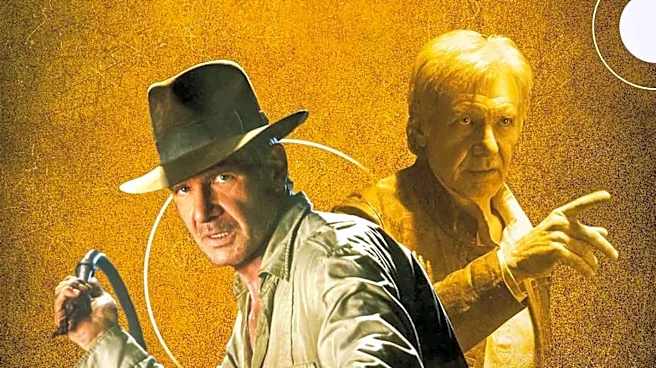
An author's attempt to overturn a copyright infringement defeat against Disney, concerning the film 'Indiana Jones and the Dial of Destiny,' has been unsuccessful. Daria Gomez Gane represented herself in the Queensland Court of Appeal, arguing that a District
Court judge in March incorrectly found that the 2023 film did not infringe upon her copyright. Gane claimed that the judge made 'factual errors' by not recognizing 'identical' parts of the film to her 2021 novella, 'The Michelangelo Dilemma: Secrets of Renaissance Time Travellers.' She asserted that Disney had taken 13 original elements from her work, including the concept of Ancient Greek mathematician Archimedes inventing a time-travel device concealed in his tomb, which she described as 'unprecedented.' However, the Court of Appeal justices questioned these claims, with Justice Thomas Bradley calling the suggestion of copyright infringement based on similar words 'ridiculous.' Walt Disney, through Lucasfilm, maintained that any minor errors in the original judgment did not support claims of similar plot, characters, or original ideas.
Why It's Important?
This ruling reinforces the legal standards for copyright infringement in the entertainment industry, particularly concerning major film studios and independent authors. The case highlights the high bar for proving that a work has been copied, especially when dealing with common genre tropes or historical elements. For creators, it underscores the difficulty in protecting broad concepts like time travel or historical figures from being used in other works, as courts often distinguish between general ideas and specific, original expressions. For large corporations like Disney, the dismissal of such claims helps to mitigate potential financial liabilities and protects their creative freedom in developing new content based on established franchises. The court's emphasis on 'commonplace stock ideas' suggests that creators must demonstrate unique and substantial similarities beyond generic plot points to succeed in copyright disputes.
What's Next?
With the Queensland Court of Appeal dismissing Daria Gomez Gane's appeal, the legal battle regarding her copyright infringement claims against Disney's 'Indiana Jones and the Dial of Destiny' appears to be concluded in Australia. The judgment by Justice Bradley, supported by Justices Mullins and Martin Burns, stated that most of Gane's examples of factual errors were 'pedantic criticisms, not clear errors.' Furthermore, any similarities between the works were deemed 'commonplace stock ideas or plot elements that naturally and almost inevitably come with the subject or genre.' This decision sets a precedent for similar cases in Australian courts, making it more challenging for authors to claim infringement based on broad thematic or historical similarities. It is unlikely that Disney will face further legal challenges from Gane on this specific matter within the Australian legal system.
Beyond the Headlines
The case delves into the nuanced legal interpretation of originality and appropriation in creative works. Gane's argument that 'Archimedes’ tomb linked to time travel is unprecedented' highlights a common challenge for authors: distinguishing between a unique combination of elements and a truly original concept. The court's rejection of this argument suggests that even novel combinations of existing ideas may not always meet the threshold for copyright protection if they are considered 'stock ideas' within a genre. This outcome could influence how authors approach pitching and protecting their intellectual property, potentially encouraging more detailed and unique narrative structures rather than relying on thematic similarities. It also underscores the power dynamics between individual creators and large media conglomerates in legal disputes, where resources and legal precedent often favor established entities.