



What's Happening?
Hyundai and Kia have filed a new patent application for a modular and magnetic hard-top assembly system designed to simplify the removal and installation of vehicle roofs. The U.S. patent application, titled 'Modular Canopy Assembly System,' describes
a design consisting of two side panels, a rear panel, and a roof panel. The innovative aspect lies in the strategic placement of magnets that assist in aligning the pieces and holding them together during assembly or disassembly. The proposed procedure involves placing the side panels, then attaching the rear piece with magnets, followed by securing it with plastic nuts. The roof panel then drops into place, guided and held by magnetism, allowing for the internal latches to be secured. This system aims to make the process a one-person job, addressing the current difficulty associated with removing hard tops on popular off-road vehicles like the Jeep Wrangler and Ford Bronco, which often require multiple people or specialized hoists.
Why It's Important?
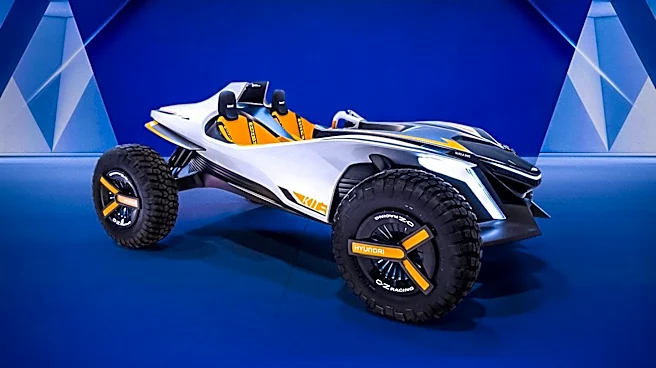
This patent is significant for the automotive industry, particularly in the growing off-road vehicle segment. By simplifying the hard-top removal process, Hyundai and Kia could offer a substantial convenience advantage over competitors. This innovation could enhance the user experience for off-road enthusiasts, making their vehicles more versatile and enjoyable. The ability to easily convert a vehicle from a closed-cabin to an open-air configuration by a single person could be a strong selling point, potentially influencing consumer preferences and market share in this niche. Furthermore, this development signals Hyundai's and Kia's serious intent to compete directly with established players in the off-road market, as Hyundai has previously stated its plans to introduce a body-on-frame off-roader for the North American market, potentially under the 'Boulder' name, and a related pickup truck. This patent could be a key differentiator for their upcoming models, offering a practical solution to a common pain point for off-road vehicle owners.
What's Next?
The patent application indicates that Hyundai and Kia are actively developing features for their upcoming off-road vehicles. While a patent does not guarantee immediate implementation, it suggests that this magnetic hard-top system is a strong candidate for future production models. The next steps would likely involve further development, testing, and refinement of the system to ensure its durability, safety, and cost-effectiveness for mass production. If successfully integrated, this technology could debut on Hyundai's planned body-on-frame off-roader, which is expected to be built in the U.S. The market's reception to this innovation will be crucial, and if positive, it could prompt other manufacturers to explore similar solutions. This could lead to a broader trend of user-friendly design improvements in the off-road vehicle segment, making these vehicles more accessible and appealing to a wider range of consumers.
Beyond the Headlines
Beyond the immediate practical benefits, this patent reflects a broader industry trend towards enhancing user convenience and modularity in vehicle design. As consumers increasingly seek personalized and adaptable vehicles, innovations that simplify customization and interaction with vehicle features become more valuable. The use of magnets, a seemingly simple technology, to solve a complex mechanical problem demonstrates creative engineering. This approach could inspire similar solutions in other areas of vehicle design, potentially leading to more intuitive and user-friendly components across various vehicle types. Moreover, the focus on making vehicle modifications a single-person task aligns with a desire for greater independence and ease of use, catering to a demographic that values self-sufficiency and direct engagement with their vehicles. This patent could therefore represent a subtle but significant shift in how automotive manufacturers approach design for specialized vehicle segments.