




What's Happening?
The World Trade Organization (WTO) has substantially increased its forecast for global merchandise (goods) trade volume growth in 2026 to 3.9%, a significant jump from the 1.9% projected in March. This upward revision is primarily attributed to the booming
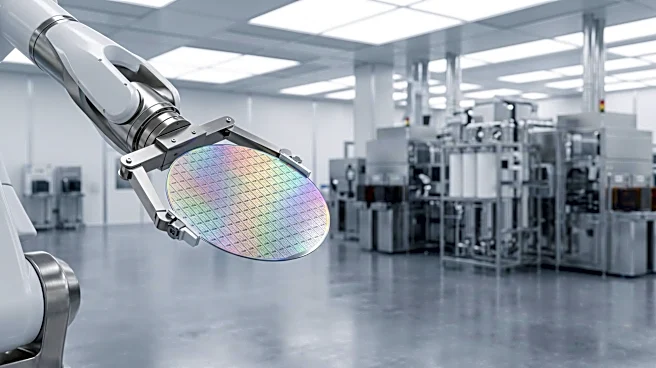
investment in Artificial Intelligence (AI)-related infrastructure, which is driving trade in semiconductors and servers. This AI-driven demand is offsetting the impact of supply disruptions caused by the ongoing conflict in the Middle East. For 2027, the WTO also revised its forecast upward to 4.1%. However, the forecast for services trade in 2026 was lowered to 3.3% due to rising aviation fuel costs and weakening travel demand. AI-enabled products accounted for 47% of global merchandise trade growth value in the first half of 2026, despite representing less than 15% of total global trade, with their trade value surging 67% year-on-year.
Why It's Important?
This revised WTO forecast has significant implications for the U.S. economy, particularly its technology and manufacturing sectors. The surge in global goods trade, largely fueled by AI-related investments, means increased demand for high-tech components, software, and data center equipment, areas where U.S. companies are global leaders. This could translate into higher export revenues, job creation, and continued innovation within the U.S. tech industry. The report highlights that North America is expected to see 5.7% export growth and 1.4% import growth in 2026, indicating a positive trade environment. However, the concentration of AI-enabled product trade among a few regions, with North America accounting for 11.5% of exports and 19.9% of imports in 2025, also suggests potential vulnerabilities if global supply chains for these specialized products are disrupted. The divergence in regional trade outlooks, with Europe and the Middle East facing contractions, underscores the uneven global economic recovery and the strategic importance of the U.S.'s position in the AI value chain.
What's Next?
The WTO's projection suggests that AI-related investment will remain the primary driver of goods trade through 2027, with global AI infrastructure spending forecast to grow at least 30% in 2026 and AI capital expenditure expected to rise another 10% to 20% in 2027. This indicates a sustained period of high demand for AI-related products and services. U.S. businesses, particularly in the semiconductor, software, and data center industries, can anticipate continued growth opportunities. Policymakers may focus on fostering an environment conducive to AI innovation and ensuring robust supply chains for critical components. However, the report also cautions that the AI boom could 'mask other problems' due to its narrow scope in sector and geography, implying that other economic sectors or regions might not experience similar growth. The ongoing Middle East conflict and its impact on supply chains will also remain a critical factor to monitor, as it could still pose risks to global trade despite the resilience shown so far.
Beyond the Headlines
The WTO's report reveals a profound shift in the global economic landscape, where AI is not just a technological advancement but a fundamental driver of international trade. This development raises deeper questions about economic equity and the potential for a widening gap between nations that are at the forefront of AI development and those that are not. The concentration of AI-enabled product trade among a few key regions, including North America, suggests that the benefits of this boom may not be evenly distributed, potentially exacerbating existing global economic disparities. Furthermore, the reliance on AI for trade growth could introduce new forms of economic vulnerability, such as dependence on specific technologies or supply chains, and raise concerns about data security and intellectual property. The report implicitly calls for a re-evaluation of global trade policies to ensure that the benefits of AI-driven growth are more broadly shared and that the risks associated with this new economic paradigm are effectively managed.