







What's Happening?
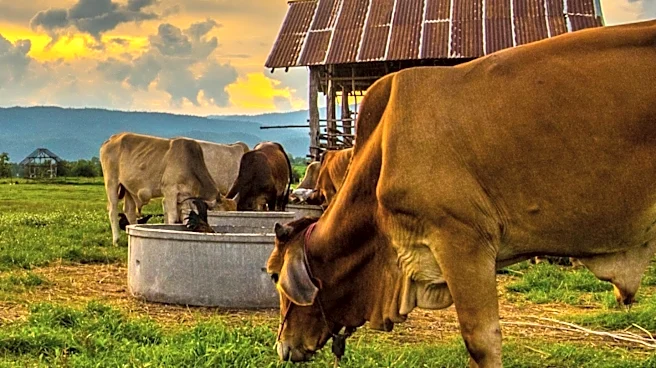
AI-powered cow detection models are being developed using YOLOv8n, leveraging the COCO 'cow' class for initial detection, with a background-subtraction (MOG2) fallback mechanism if model weights are unavailable. This approach aims to utilize existing
video infrastructure on farms without requiring new hardware or per-animal sensor costs. The detection system employs a basic centroid tracker for tracking individual cows, designed for efficiency with approximately 70 lines of code, focusing on nearest-centroid matching and a disappearance tolerance to maintain cow IDs during brief occlusions. The goal is to identify motion patterns per animal over time to flag potential wellbeing issues for farm managers, rather than providing veterinary diagnoses. Real-time signals from cow sensors are also integrated to track calving and rumination, alongside environmental data from temperature, humidity, and CO2 sensors, all feeding into a comprehensive 'Cow360' system for farm management dashboards and AI agents.
Why It's Important?
The development of AI-powered cow detection models signifies a significant advancement in smart farming technologies, particularly for dairy operations. By utilizing existing camera infrastructure and readily available AI models, this technology offers a cost-effective solution for livestock monitoring, potentially reducing the reliance on expensive wearables or manual observation. This innovation can lead to more efficient farm management by providing early alerts for changes in animal behavior, which could indicate health issues or approaching calving. For the U.S. dairy industry, this could translate into improved animal welfare, reduced labor costs, and enhanced productivity. The integration of video analytics with sensor data creates a holistic view of individual animal health and barn conditions, enabling data-driven decisions that optimize feeding, climate control, and breeding cycles. This shift towards precision dairy farming can bolster the economic sustainability of farms by minimizing losses and maximizing output.
What's Next?
The immediate next steps for AI-powered cow detection models involve further validation and refinement. Developers plan to run more barn footage through the system to validate activity thresholds and improve accuracy. Future enhancements aim to replace the current heuristic skeleton overlay with real pose estimation for more precise gait and joint angle measurements. The current system's ability to identify contradictions, such as high herd activity alongside individual inactivity, highlights areas for improvement in reporting and data interpretation. As the technology matures, it is expected to integrate more deeply with existing farm management systems, providing richer insights and more actionable recommendations. The broader adoption of such AI solutions will likely depend on demonstrating clear economic benefits and ease of integration for farmers. Continued research will focus on expanding the capabilities of these models to diagnose specific health conditions, further reducing the need for manual intervention and improving proactive animal care.
Beyond the Headlines
The application of AI in livestock monitoring extends beyond immediate operational efficiencies, touching upon broader ethical and societal implications. The ability to continuously monitor animal welfare through non-invasive means could lead to higher standards of animal care, addressing growing consumer demand for ethically sourced agricultural products. This technology also represents a step towards greater transparency in farming practices, as data-driven insights can provide verifiable evidence of animal well-being. However, it also raises questions about data privacy and security in agricultural settings, as detailed information about individual animals and farm operations is collected and analyzed. The reliance on AI for decision support could also alter the traditional role of farmers, shifting from hands-on observation to data interpretation and system management. Furthermore, the accessibility of such advanced technologies to smaller farms will be crucial to prevent a widening gap between large-scale and small-scale agricultural producers, ensuring that the benefits of smart farming are broadly distributed across the industry.