





What's Happening?
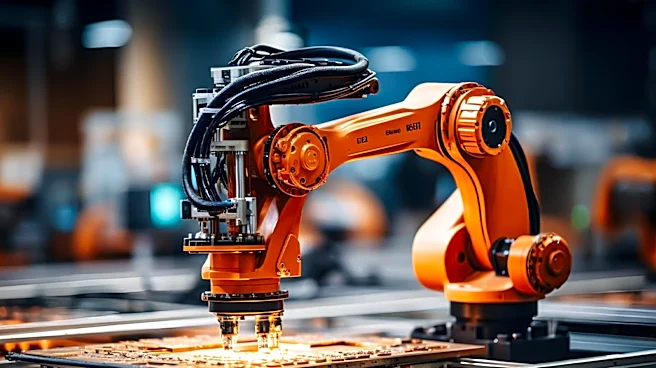
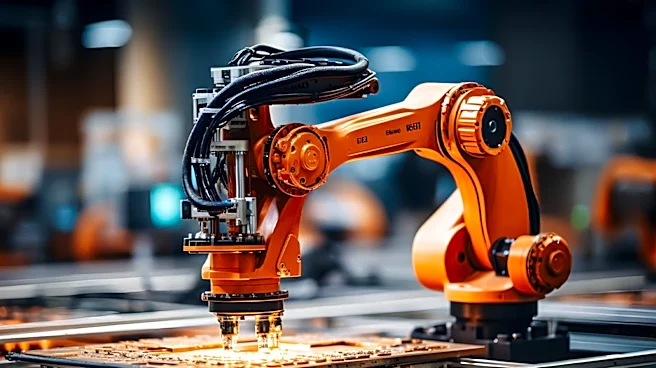
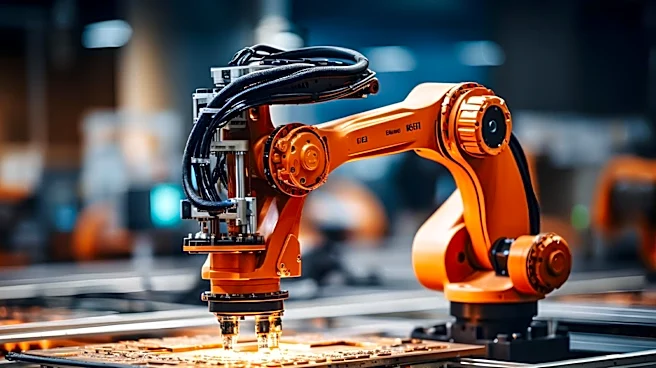
Universal Robots has developed its Gen 7 platform to integrate physical AI into manufacturing processes, addressing the challenges posed by variability in the physical world. Traditional industrial automation often struggles with inconsistencies such
as moving parts, deforming materials, and changing product mixes, leading to extensive engineering work for adjustments and updates. Physical AI connects artificial intelligence to machines that can sense and act in the physical environment, allowing robots to adapt to these variations. The Gen 7 platform aims to enhance perception, adaptability, and software capabilities in automation, making previously difficult or uneconomical automation projects viable. This development is particularly relevant for applications where the robot encounters different conditions over time, moving beyond the limitations of conventional, highly predictable robotic tasks.
Why It's Important?
The introduction of physical AI through platforms like Universal Robots' Gen 7 marks a significant advancement in industrial automation. It expands the scope of what can be automated, enabling manufacturers to tackle complex tasks that were previously too variable or costly for traditional robotics. This can lead to increased efficiency, reduced manual labor in challenging environments, and greater flexibility in production lines. For U.S. manufacturing, this technology could enhance competitiveness by allowing for more agile responses to market demands and product changes. It also signifies a shift in the automation industry, where the focus is moving from rigid, pre-programmed tasks to more intelligent, adaptive systems. Companies that adopt physical AI may gain a substantial advantage in terms of productivity and operational resilience, while those that do not may fall behind in an increasingly automated global market.
What's Next?
Manufacturers will now need to evaluate how physical AI and platforms like Gen 7 can be practically applied to their specific production challenges. The core principles of automation, such as business case justification, tooling, integration, safety, reliability, and maintainability, will remain crucial, but the boundary of what can be reasonably automated will expand. This means engineers will have more tools to investigate and implement automation solutions for processes that involve inherent variability. The adoption of physical AI is expected to grow as manufacturers seek to optimize operations and reduce reliance on manual intervention in dynamic environments. Further development in this area will likely focus on refining the AI's ability to interpret sensory data and execute precise actions in real-time, making robots even more versatile and capable of handling a wider array of manufacturing tasks.
Beyond the Headlines
The integration of physical AI into manufacturing raises deeper implications beyond immediate productivity gains. It signifies a move towards more autonomous and intelligent factory floors, potentially leading to a redefinition of human roles in manufacturing, shifting from direct labor to oversight, maintenance, and strategic planning. Ethical considerations around the increasing autonomy of machines in physical spaces, as well as the need for robust safety protocols, will become more prominent. Furthermore, the widespread adoption of such advanced automation could impact labor markets, requiring a re-skilling of the workforce to manage and interact with these sophisticated AI-driven systems. The long-term shift could be towards highly flexible, self-optimizing production systems that can adapt to unforeseen circumstances and rapidly changing consumer demands, fundamentally altering the landscape of industrial production.