


What's Happening?
Tokyo-based O-ID has successfully raised $1.2 million in pre-seed funding to advance the development of its modular humanoid robots designed for industrial manufacturing and logistics. The funding round was led by Chicago-based TAWANI Ventures, with additional
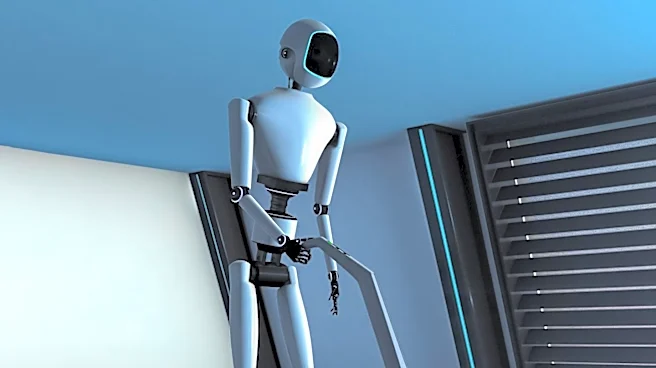
participation from Hustle Fund, Techstars, and angel investors, including the founders of Humanoid Guide. O-ID plans to utilize these funds to transition its first robot prototype into production, with initial deployment slated for Japanese factory floors. The company emphasizes the modular design of its robots, featuring hot-swappable joints, limbs, and compute units, which allows for on-site repairs in minutes and minimizes downtime. O-ID has also filed a provisional U.S. patent for its modular connector technology and is exploring collaborations with Sumitomo Electric Industries for wire harness technologies. The company's Delaware parent, O-ID, Inc., manages fundraising and international corporate activities, while its Japanese entity focuses on R&D, manufacturing, and deployment.
Why It's Important?
This development is significant for the U.S. manufacturing sector, which faces a projected shortage of 3.8 million workers by 2033, with up to 1.9 million jobs potentially going unfilled. O-ID's modular humanoid robots offer a potential solution to this labor gap by working alongside human employees, thereby mitigating risks to supply chains caused by unfilled factory roles. The company's intention to expand into the U.S. market, coupled with its robots being designed to meet the requirements of the U.S. National Defense Authorization Act, indicates a strategic focus on addressing American industrial needs. The investment from a U.S.-based firm like TAWANI Ventures underscores the perceived value and potential impact of O-ID's technology on enhancing industrial productivity and addressing labor challenges in the U.S. The ability to quickly repair robots on-site could also significantly reduce costly downtime for U.S. manufacturers, where an hour of downtime in large automotive plants can cost millions.
What's Next?
O-ID's immediate next steps involve moving its first robot from prototype to production and deploying it in Japanese factories. Following this, the company plans to expand its operations into other industries and the U.S. market. The provisional U.S. patent filing for its modular connector technology suggests a clear path toward establishing intellectual property in the United States, facilitating future market entry. Discussions with Sumitomo Electric Industries regarding wire harness technologies could lead to further advancements in the robots' design and functionality. As O-ID aims to ship its robots to the U.S., it will likely focus on demonstrating compliance with U.S. industrial safety standards and the National Defense Authorization Act to ensure smooth integration into American manufacturing and logistics operations. The company's success in Japan will likely inform its strategy for U.S. market penetration.
Beyond the Headlines
The emergence of highly modular and easily repairable humanoid robots like those developed by O-ID could represent a paradigm shift in industrial automation. Unlike traditional, rigid industrial robots that require extensive factory reconfigurations and costly, lengthy repairs, O-ID's approach emphasizes flexibility and rapid maintenance. This could democratize access to advanced robotics for a wider range of manufacturers, including smaller and medium-sized enterprises, by reducing the initial investment and operational complexities. Furthermore, the focus on robots working alongside humans, rather than replacing them entirely, suggests a future where automation augments the human workforce, addressing labor shortages without necessarily leading to widespread job displacement. This could foster a more collaborative human-robot work environment, potentially leading to new skill sets and job roles in robot maintenance and supervision. The ethical implications of integrating AI-controlled robots into the workforce, particularly concerning worker safety and the evolving nature of human labor, will also become increasingly pertinent.