








What's Happening?
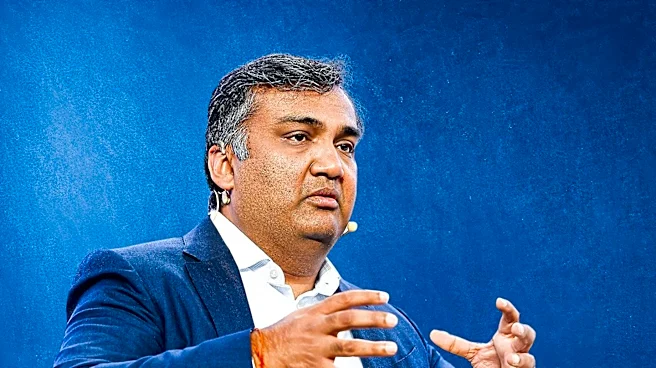
IBM CEO Arvind Krishna is urging solution providers to prioritize trust and strategic deployment in the rapidly evolving artificial intelligence landscape. Krishna highlights IBM's significant AI business, which reported over $4 billion in annual recurring
revenue in its first fiscal quarter, with its AI platform, agents, assistants, and orchestration business exceeding $1.5 billion with only 25% penetration. He believes AI can boost productivity by 30 to 40 percent, and in some cases, even 10 to 20 times. Krishna advises partners to move beyond experimentation and focus on scaling AI solutions to achieve tangible returns on investment. He stresses the importance of long-term partnerships and IBM's historical commitment to supporting its partners for sustained growth. The company aims to double the impact partners have on its business, moving from approximately one-quarter of its revenue currently touched by partners to half, which would require partner revenue to triple.
Why It's Important?
This strategic focus by IBM on trust and partner-led AI deployment is crucial for the U.S. technology industry. As AI adoption accelerates, businesses face challenges in identifying reliable solutions and navigating complex implementations. IBM's emphasis on long-term partnerships and its substantial investment in AI, including recent acquisitions like Confluent and HashiCorp, positions its partners to become trusted advisors for clients seeking to integrate AI effectively. This approach can help mitigate risks associated with rapid technological shifts and potential vendor lock-in, which Krishna warns against given the unpredictability of AI pricing models. By empowering solution providers to guide clients in strategic AI deployment, IBM aims to drive widespread productivity improvements across various sectors, from enterprise operations to new application development, ultimately fostering economic growth and innovation within the U.S. market.
What's Next?
IBM plans to continue expanding its partner ecosystem, particularly targeting the next 100,000 customers where it aims to be largely partner-led. This strategy involves providing partners with the necessary expertise and resources to help clients deploy AI in existing applications or build new ones, unlock data, and prepare their data for AI. IBM Channel Chief Kareem Yusuf is focused on building a vibrant ecosystem by aligning with partners' priorities and offering clarity and simplicity in engagements. New initiatives like Auto Deal Share, launched in July, aim to increase automation in lead sharing and remove friction in deal communication. IBM will also continue to invest in its four core platforms: mainframe, hybrid cloud (including Red Hat), AI, and quantum computing, which Krishna views as strong 'moats' for the company's long-term success. Partners are encouraged to leverage IBM's supply chain management for Power and Storage products, which have seen significant growth and backlog.
Beyond the Headlines
The emphasis on 'trust' in the AI era by IBM CEO Arvind Krishna extends beyond mere business transactions, touching upon deeper ethical and security considerations. As AI models become more sophisticated, the potential for AI-driven cyberattacks and data vulnerabilities increases. IBM's focus on layered defenses and solutions like Lightwell, designed to protect against open-source software attacks, highlights the critical need for robust cybersecurity in AI adoption. Furthermore, Krishna's advice against vendor lock-in underscores the importance of flexibility and open standards in the evolving AI landscape, promoting a more resilient and adaptable technological infrastructure. This approach also reflects a broader industry shift towards responsible AI development and deployment, where the long-term implications of AI on business logic, data accuracy, and societal impact are carefully considered, moving beyond initial experimentation to scaled, value-driven implementation.