





What's Happening?
Avicena, a U.S.-based optical interconnect company, has completed a Series C financing round exceeding $100 million, attracting significant investment from industry players including AMD Ventures, Samsung, and SK Hynix. Avicena specializes in its LightBundle
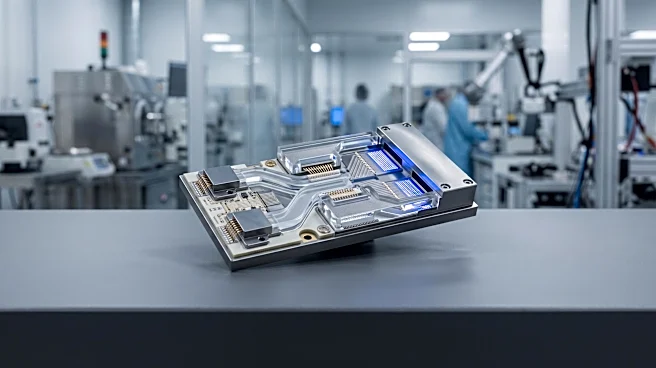
optical interconnect platform, which utilizes MicroLEDs as light sources to create parallel optical connection systems. This approach, termed 'Wide and Slow,' aims to achieve higher overall bandwidth by distributing data across numerous relatively low-speed channels, rather than continuously increasing the speed of a single channel. This technology addresses the growing data exchange demands within AI clusters, where traditional copper interconnects face limitations in transmission distance, wiring density, and energy consumption. Avicena's technology integrates MicroLEDs, silicon photodetectors, and multi-core optical fibers, and the company has demonstrated technical samples with significant bandwidth and low power consumption.
Why It's Important?
The investment by AMD and other major industry players into Avicena's MicroLED optical interconnect technology signals a strategic shift in addressing the escalating data transmission challenges within AI infrastructure. As AI clusters expand, the need for greater bandwidth, lower power consumption, and higher bandwidth density between GPUs, memory, and switching chips becomes critical. Traditional high-speed interconnects often lead to increased system complexity and signal integrity issues. Avicena's 'Wide and Slow' approach offers a potential solution by leveraging parallel, lower-speed channels, which could lead to more efficient and scalable AI systems. This development is crucial for the U.S. technology sector, particularly for companies like AMD that are heavily invested in AI computing, as it could unlock new levels of performance and energy efficiency in next-generation AI hardware.
What's Next?
Avicena is actively moving from technical demonstrations to product verification, having released LightBundle evaluation kits and begun delivering 1Tbps-level kits to customers and partners. The company aims for 2027 as a significant commercialization milestone. This financing will accelerate product development, expand the engineering team, and promote commercialization efforts. AMD's multi-pronged strategy in optical interconnects, which includes the acquisition of Enosemi and participation in the Optical Compute Interconnect (OCI) alliance, suggests a broad exploration of various technical routes. While it's not yet clear if AMD's future AI systems will adopt MicroLEDs, the investment indicates a strong interest in exploring this technology as a viable solution for the evolving demands of AI data transmission. The industry will be watching for further product developments, customer verifications, and the eventual integration of these technologies into commercial AI systems.
Beyond the Headlines
The diversification of optical interconnect technologies, as exemplified by Avicena's MicroLED approach, highlights a broader industry trend towards specialized solutions for specific data transmission challenges. While traditional laser-based optical communication has been dominant, the unique requirements of short-distance, high-bandwidth-density connections within AI systems are fostering innovation in areas like MicroLEDs and silicon photonics. This competition among different technical routes underscores the complexity and rapid evolution of AI infrastructure. The success of Avicena's MicroLED technology will depend on its ability to overcome challenges related to manufacturing consistency, fiber alignment, reliability, and cost-effectiveness at scale. The strategic investments by major players like AMD, Samsung, and SK Hynix also reflect a recognition that data movement capabilities are becoming as critical as raw computing power in the race to develop advanced AI systems, potentially reshaping the competitive landscape of the semiconductor and AI industries.