
What's Happening?
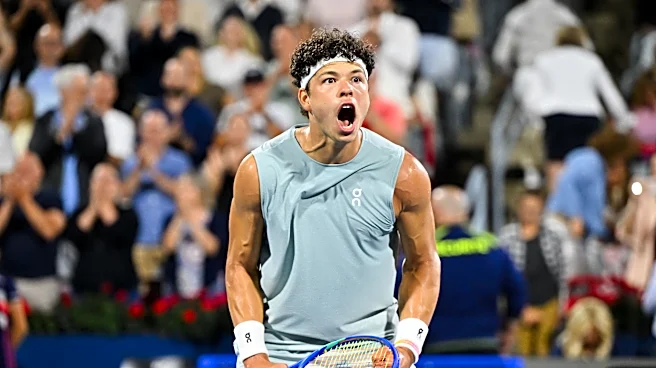
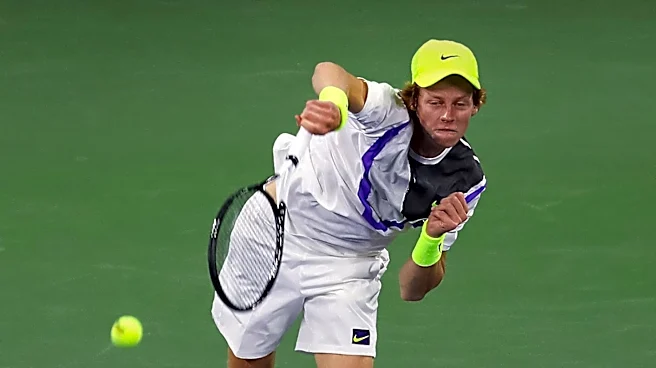
American tennis player Ben Shelton issued a quick apology during his pre-U.S. Open press conference after reacting animatedly to a question about his serve quality. Shelton, who reached the semifinals
of the 2023 U.S. Open, expressed frustration with analytics that he believes inaccurately assess the effectiveness of his serves, particularly kick serves. He cited an instance from the Montreal tournament where, despite feeling he served exceptionally well, his average serve quality score was lower than expected. Shelton clarified that while he monitors analytics, he doesn't always agree with their conclusions, emphasizing that factors beyond just speed contribute to a successful serve. He acknowledged his 'hot' demeanor, attributing it to his passion for the sport and commitment to improvement.
Why It's Important?
This incident highlights the growing tension between traditional athletic assessment and the increasing reliance on data analytics in professional sports. For athletes like Ben Shelton, who possess powerful and nuanced skills, the reduction of performance to numerical metrics can be frustrating and potentially misrepresent their true capabilities. The exchange underscores the importance of a holistic understanding of athletic performance, where qualitative aspects and strategic execution are as crucial as quantifiable data. This dynamic can influence how athletes train, how coaches strategize, and how the media and fans perceive player performance, potentially leading to debates about the true value of advanced analytics in sports. It also reflects the pressure on top athletes to maintain composure under scrutiny, even when facing questions they find challenging or misinformed.
What's Next?
As Ben Shelton prepares for his first-round match against Tallon Griekspoor at the U.S. Open, his focus will likely shift entirely to his on-court performance. His comments suggest a determination to prove his capabilities through play rather than through analytical scores. The incident may prompt further discussion among sports analysts and the tennis community regarding the interpretation and application of serve quality metrics. Shelton's performance in the tournament will be closely watched, particularly his serve, as he aims to surpass his 2023 semifinal run. His emphasis on staying in the moment and respecting all opponents indicates a strategic mindset focused on individual matches rather than the broader draw, which could be key to his progression in the tournament.
Beyond the Headlines
The interaction between Ben Shelton and the media touches upon broader themes of communication and perception in the high-stakes world of professional sports. Athletes are often expected to be articulate and composed, even when confronted with questions that challenge their professional integrity or understanding of their own game. Shelton's quick apology and explanation demonstrate an awareness of this expectation, while his initial reaction reveals the underlying passion and frustration that can come with elite competition. This scenario also raises questions about the role of sports journalism in critically evaluating and presenting analytical data, ensuring that it complements rather than overshadows the human element of athletic achievement. The incident could serve as a reminder that while data provides valuable insights, it should not be the sole determinant of an athlete's skill or effort.