

What's Happening?
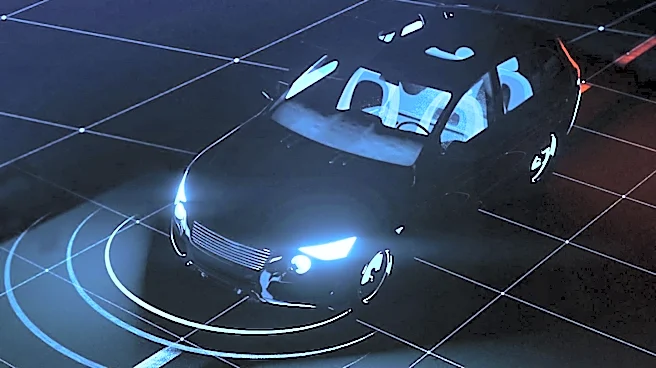
Tesla's latest Full Self-Driving (FSD) software update, v15, is reportedly the final iteration designed to run on the company's AI4 computer hardware in customer vehicles. Elon Musk, CEO of Tesla, explained on X that the new software, which includes a graphical
upgrade called 'Reality View,' utilizes a significant portion of the AI4's processing power, leaving minimal room for further enhancements. Musk also confirmed that future, more powerful AI chips, specifically AI5 and AI6, will be allocated to the Optimus robot project rather than being integrated into Tesla cars. The mid-cycle AI4.5 upgrade for vehicles has also seen its RAM reduced from 32GB to 24GB, primarily due to the need for a newer, more readily available memory type, rather than to unlock larger models. This development suggests that the AI4 hardware is being pushed to its maximum capacity for FSD capabilities.
Why It's Important?
This announcement has significant implications for current and prospective Tesla owners, particularly those who purchased vehicles with the understanding that their hardware would eventually support unsupervised self-driving. The decision to prioritize AI5 and AI6 for Optimus means that the AI4 computer in existing cars will not receive the substantial hardware upgrades previously anticipated. This could lead to a ceiling in the performance and capabilities of FSD in current vehicles, potentially impacting the long-term value proposition of Tesla's self-driving features. Furthermore, the focus on Optimus highlights Tesla's strategic shift towards robotics, which could divert resources and development away from automotive AI advancements. The situation also raises questions about hardware redundancy for Level 4 autonomous driving, as Musk's descriptions suggest the AI4's two chips are actively sharing workloads rather than one serving as a dedicated failover, a critical component for safety in fully autonomous systems.
What's Next?
Tesla is rolling out FSD v15 to a wider audience in the coming month, following initial testing by early adopters. The performance of v15 on the AI4 hardware will be closely scrutinized, particularly regarding its ability to achieve unsupervised driving without frequent interventions. Owners of HW3 vehicles, who have been awaiting upgrades, may find their expectations further challenged by the news that AI5 will not be coming to cars. The company will likely face continued pressure to clarify its long-term strategy for FSD hardware upgrades in its automotive fleet. The production of AI5 volume at Samsung's Texas fab is not expected until the second half of 2027, and this volume is now earmarked for robots and data centers, indicating a clear future direction for Tesla's advanced AI hardware deployment.
Beyond the Headlines
The situation with Tesla's FSD hardware and software development underscores the complex challenges of achieving true Level 4 or Level 5 autonomous driving. The continuous evolution of AI models and the demanding computational requirements highlight the rapid obsolescence of hardware in this field. The ethical and legal implications of hardware limitations in self-driving systems, particularly concerning safety and redundancy, remain a critical area of discussion. If the AI4 hardware proves insufficient for fully unsupervised driving, it could lead to a re-evaluation of Tesla's promises and potentially impact consumer trust. This also reflects a broader industry trend where the development of advanced AI for specialized applications, such as robotics, may take precedence over incremental improvements in existing product lines, signaling a potential shift in technological priorities for leading companies.