




What's Happening?
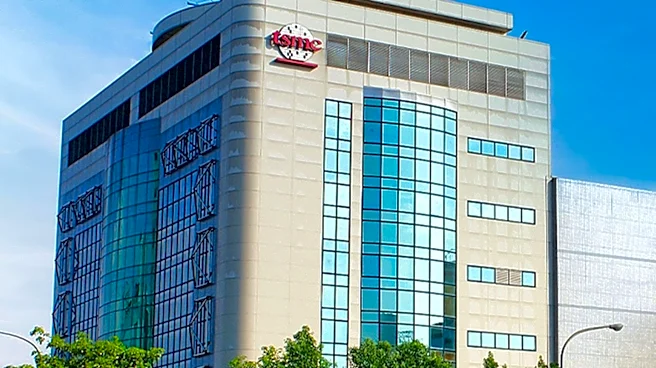
TSMC, a leading semiconductor manufacturer, has significantly revised its forecast for the global semiconductor industry, now projecting it to reach approximately $1.7 trillion by the end of the year. This updated outlook, presented at TSMC's Open Innovation
Partners North America Technology Symposium, far surpasses an earlier forecast from January 2024 which anticipated a $1 trillion market by 2030. The dramatic acceleration in growth is primarily attributed to the surging demand for AI-specific semiconductors, which are expected to account for over $1 trillion of the total market. TSMC's own revenue figures reflect this trend, showing a 53.3% year-over-year increase and a 39.3% rise in comparable January-to-August numbers for 2025 and 2026, highlighting the immense impact of AI on the industry.
Why It's Important?
This revised forecast from TSMC carries immense importance for the U.S. economy and technology sector. The projected $1.7 trillion semiconductor market, with a substantial portion driven by AI, indicates a massive influx of investment and innovation in advanced computing. For U.S. industries, this means accelerated development in AI capabilities, impacting sectors from healthcare and finance to defense and manufacturing. Companies involved in AI hardware, software, and services stand to gain significantly from this growth. The increased demand for advanced nodes (N5, N3, N2) and the rapid increase in new tape-outs (NTOs) signal a robust period of technological advancement and competition. This growth also underscores the critical need for robust supply chains and domestic manufacturing capabilities, influencing U.S. policy decisions related to semiconductor production and research funding, such as the CHIPS Act.
What's Next?
The semiconductor industry is expected to continue its rapid expansion, with TSMC's L.C. Lu noting that power scaling will extend Moore's Law, and significant improvements in memory bandwidth and energy efficiency are anticipated by 2029. The focus will remain on addressing AI scaling challenges, including compute, memory density, and power consumption. TSMC is actively collaborating with partners like imec, Amazon Web Services (AWS), and Microsoft Azure, and developing AI Design Kits (ADK) to facilitate AI-driven chip design flows. This collaborative approach, coupled with advancements like TSMC-COUPE for energy-efficient high-speed communication, suggests a future where AI not only drives demand but also accelerates the design and manufacturing of next-generation chips. Stakeholders will likely see continued investment in R&D, strategic partnerships, and efforts to enhance manufacturing capacity to meet the escalating demand.
Beyond the Headlines
The exponential growth in the semiconductor industry, particularly fueled by AI, signifies a profound transformation in global technological infrastructure. This isn't merely an economic boom; it represents a fundamental shift in how technology is developed and utilized. The 'positive feedback environment' where AI advances lead to new tools for AI development creates a self-reinforcing cycle of innovation. This could lead to unprecedented breakthroughs in various scientific and engineering fields, but also raises ethical considerations regarding the responsible development and deployment of increasingly powerful AI systems. The shift from the 'SoC era' to the 'SiP' (System-in-Package) era, as noted by Broadcom's Greg Dix, indicates a move towards more integrated and complex chip designs, which will require new skill sets and collaborative models across the industry. This trajectory will shape not only the future of computing but also societal structures and human-technology interaction for decades to come.