






What's Happening?
Tower Semiconductor announced record sales of US$526.16 million and net income of US$120.26 million for the third quarter of 2026. Both revenue and earnings from continuing operations were higher than in the same period of 2025. A significant driver of this
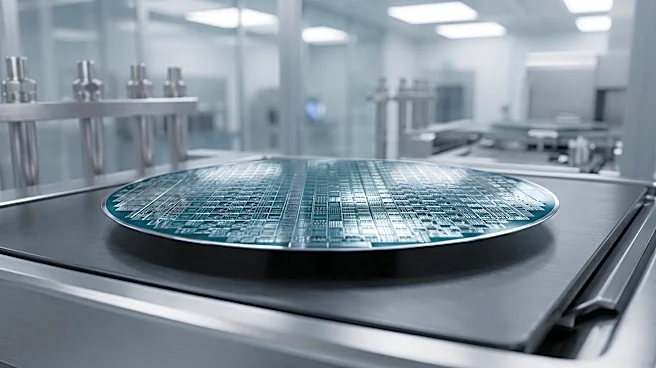
performance was the company's silicon photonics business, which generated approximately US$240 million in quarterly revenue. This growth is supported by multi-year customer commitments and a substantial US$920 million capacity build program aimed at increasing output from both 200mm and 300mm fabs. Management's focus on silicon photonics and the ramp-up of SiGe technology are central to the company's strategy to evolve into a higher-margin, higher-mix operation. The company's analyst narrative projects US$4.6 billion in revenue and US$1.6 billion in earnings by 2029, based on an assumed 35.9% yearly revenue growth rate.
Why It's Important?
Tower Semiconductor's record quarterly revenue, largely fueled by its silicon photonics business, highlights the increasing demand for advanced semiconductor solutions, particularly those supporting AI data centers. This performance indicates a strong market for specialized foundry services and the critical role of silicon photonics in next-generation computing infrastructure. For U.S. technology and AI sectors, Tower Semiconductor's expansion signifies a robust supply chain for essential components, potentially mitigating risks associated with reliance on overseas manufacturing. The substantial investment in capacity expansion, including the US$920 million program, underscores confidence in sustained demand but also introduces the risk of overbuilding if customer volumes do not materialize as planned. The company's strategic shift towards higher-margin, higher-mix operations through silicon photonics and SiGe technologies is crucial for its long-term profitability and competitive positioning in the rapidly evolving semiconductor landscape.
What's Next?
Tower Semiconductor's future performance will largely depend on its ability to effectively fill its expanded silicon photonics capacity with committed AI data center demand. The company's multi-year customer commitments extending through 2029 provide a degree of stability, but the risk of underutilized capacity remains a key concern for analysts. Sampling timelines for new products, such as AI-server MOSFET and IGBT modules within approximately 12 months and 800-volt protection products by the second half of 2027, will serve as measurable checkpoints for investors. The company's strategic partnerships and product launches are expected to be major catalysts. Analyst coverage, currently thin and cautious, could see revisions as these developments unfold, potentially influencing stock sentiment. The broader market's demand for AI infrastructure will continue to be a significant factor in Tower Semiconductor's growth trajectory.
Beyond the Headlines
The success of Tower Semiconductor's silicon photonics business reflects a broader industry trend towards integrating optical technologies with silicon for enhanced data processing and communication. This convergence is critical for addressing the escalating demands of AI and high-performance computing, where traditional electronic interconnects are becoming bottlenecks. The company's investment in this area suggests a strategic foresight in anticipating future technological needs. However, the capital-intensive nature of semiconductor manufacturing, coupled with the rapid pace of technological change, means that companies like Tower Semiconductor must constantly innovate and manage significant financial risks. The potential for overbuilding capacity, as highlighted by analysts, underscores the cyclical nature of the semiconductor industry and the challenges of forecasting demand in a fast-evolving market. This also raises questions about the sustainability of current growth rates and profit margins across the semiconductor sector.