



What's Happening?
Engineers at Kansas State University (K-State) have developed a new system designed to significantly improve the accuracy of crop sprayers, addressing a long-standing agricultural problem. The team, led by doctoral candidate Aryan Singh Dalal and Professor
Ajay Sharda, has created a system that measures the movement of a crop sprayer's boom during field work. This technology uses a single camera mounted on the sprayer chassis, aimed at a custom-designed 3D target on the boom tip, about 60 feet away. A neural network then processes the camera's images to locate the target and convert its movement into precise distance measurements. This system can measure boom movement to within approximately an inch, even for swings and bounces of up to 10 feet, which commonly occur when sprayers operate at high speeds or on uneven terrain. The research has been published in the journal *Computers and Electronics in Agriculture*, and a related U.S. patent has been assigned jointly to K-State and CNH Industrial America.
Why It's Important?
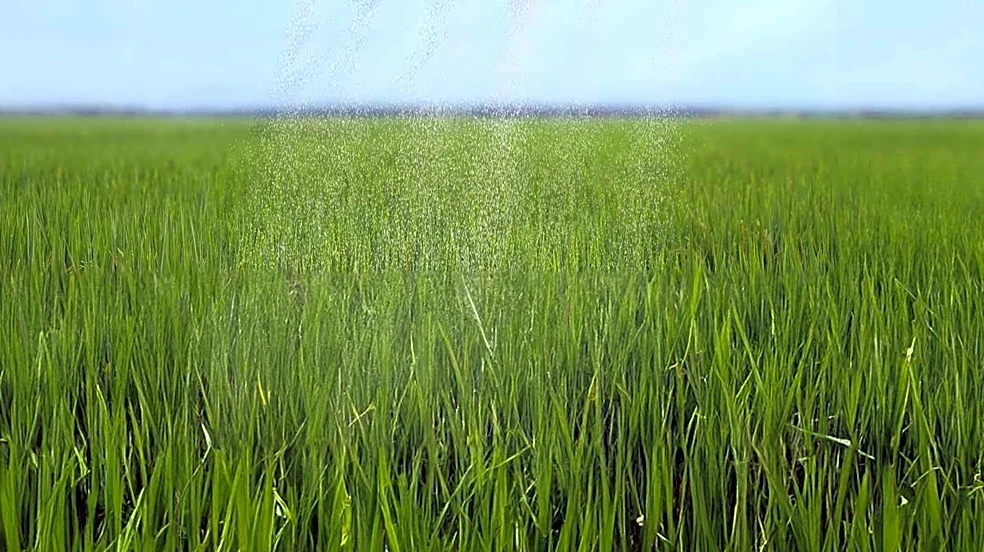
The accuracy of crop spraying is critical for farmers worldwide, directly impacting profitability and resource efficiency. Inaccurate spraying leads to significant waste of expensive inputs like seeds, water, and fertilizer, as well as potential environmental damage from overuse in some areas and reduced crop yield in others due to under-application. Modern sprayers with booms up to 125 feet wide, operating at speeds approaching 19 mph, are highly susceptible to boom sway and bounce, causing nozzles to misapply products. This new K-State technology offers a precise solution to this problem, enabling more efficient use of resources, reducing operational costs for farmers, and minimizing environmental impact. The patent, co-assigned with CNH Industrial America, signals a strong potential for industrialization and widespread adoption, which could revolutionize application accuracy in large-scale agriculture.
What's Next?
The patented technology is currently awaiting industrialization to be made available to the agriculture industry. The patent covers the next phase of the system, which will use the sprayer's own data—including speed, acceleration, and a model of the specific boom—to predict its ideal position. It will then measure deviations and respond by automatically adjusting nozzle output, repositioning boom sections, changing ground speed, or alerting the operator. Crucially, the system is designed to update its own model when predictions are significantly off, allowing for continuous improvement and adaptation. This integration of predictive analytics and real-time adjustments promises to further enhance application accuracy. The collaboration with CNH Industrial America suggests that this technology could soon be incorporated into commercial agricultural equipment, bringing its benefits directly to farmers.
Beyond the Headlines
This innovation from K-State has broader implications for the future of precision agriculture and the role of artificial intelligence in farming. The development of a robust, camera-based system for real-time boom monitoring represents a significant step towards fully autonomous and highly optimized agricultural operations. The use of a neural network to interpret visual data highlights the increasing sophistication of AI applications in solving complex real-world problems. Furthermore, the creation of a custom 3D marker, modeled on a biological form and designed to be distinct from agricultural environments, showcases interdisciplinary thinking and creative problem-solving. This technology not only addresses a practical challenge but also contributes to the ongoing evolution of smart farming, where data-driven decisions and automated systems lead to more sustainable and productive agricultural practices, ultimately contributing to global food security.