







What's Happening?
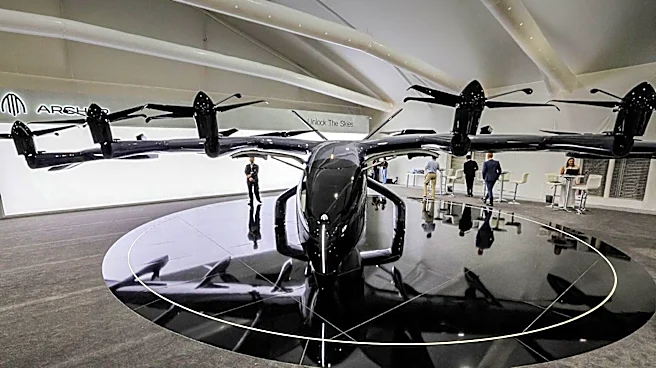
Archer Aviation, a developer of electric vertical takeoff and landing (eVTOL) aircraft, has commenced its 'No Roads Flight Tour' with the inaugural city-to-city flight of its Midnight eVTOL vehicle. The roundtrip flight occurred between Salinas Municipal
Airport and Hollister Municipal Airport in California, taking 12 minutes each way. This journey, covering 40 miles at 125 mph and an altitude of 3,500 feet, significantly reduced travel time compared to the estimated 40-minute drive. The tour is part of a broader flight test program being conducted across the U.S. in collaboration with the Federal Aviation Administration (FAA). The Midnight eVTOL is designed to carry four passengers, a pilot, and carry-on luggage, targeting trips between 20 to 50 miles with quick 10-minute battery recharges between flights. The vehicle features 12 engines and propellers with redundant systems, capable of speeds up to 150 mph, and is intended for back-to-back operations. Future legs of the 'No Roads Flight Tour' are planned for other cities in California, Texas, and Florida.
Why It's Important?
This initiative by Archer Aviation marks a significant step in the development and public demonstration of urban air mobility solutions in the U.S. The successful city-to-city flight showcases the potential for eVTOL technology to revolutionize short-distance travel, offering a faster and potentially more efficient alternative to ground transportation. By reducing a 40-minute drive to a 12-minute flight, Archer Aviation highlights the practical benefits of its Midnight air taxi in alleviating traffic congestion and improving connectivity between urban and suburban areas. The 'No Roads Flight Tour' is crucial for public acceptance and regulatory confidence, as it provides real-world data and visibility into the operational capabilities and safety of eVTOL aircraft. Furthermore, the collaboration with the FAA during this flight test program is vital for advancing the certification process, which is essential for the commercial deployment of air taxi services. The development of vertiports and air mobility networks, such as those planned for Los Angeles, indicates a future where air taxis could become an integrated part of urban infrastructure, impacting local economies and transportation planning.
What's Next?
Archer Aviation plans to continue its 'No Roads Flight Tour' with additional city-to-city flights in California, Texas, and Florida, aiming to further demonstrate the advantages of eVTOL travel. These ongoing tests are integral to the company's flight test program and its coordination with the FAA for certification. The company is also actively developing its air mobility network in Los Angeles, including plans for a vertiport at the L.A. Live sports and entertainment district in partnership with AEG, making Archer the exclusive air taxi partner for L.A. Live. This network will include vertiports at key locations such as Los Angeles International Airport, Orange County, Santa Monica, Hollywood Burbank, Long Beach, and Van Nuys. Archer's goal is to enable rapid transit across the city, with trips taking 10 to 20 minutes. The acquisition of Hawthorne Airport as a central operational hub further solidifies its infrastructure development. The ultimate objective is to achieve FAA certification and launch commercial air taxi services, potentially replacing ground trips that typically take 60 to 90 minutes.
Beyond the Headlines
The advancement of eVTOL technology, as demonstrated by Archer Aviation's 'No Roads Flight Tour,' carries profound implications beyond mere transportation efficiency. It signals a potential paradigm shift in urban planning and infrastructure development, necessitating new regulatory frameworks for air traffic management in lower altitudes and the integration of vertiports into existing urban landscapes. The ethical considerations surrounding noise pollution, energy consumption, and equitable access to these advanced transportation methods will become increasingly prominent. Furthermore, the widespread adoption of air taxis could reshape real estate values in areas with vertiport access and influence migration patterns as commuting times become less of a barrier. The development also highlights the ongoing race among aerospace companies to dominate the nascent urban air mobility market, pushing the boundaries of electric propulsion and autonomous flight technologies. The success of these ventures will depend not only on technological prowess but also on public trust, robust safety standards, and effective integration into complex urban environments.