


What's Happening?
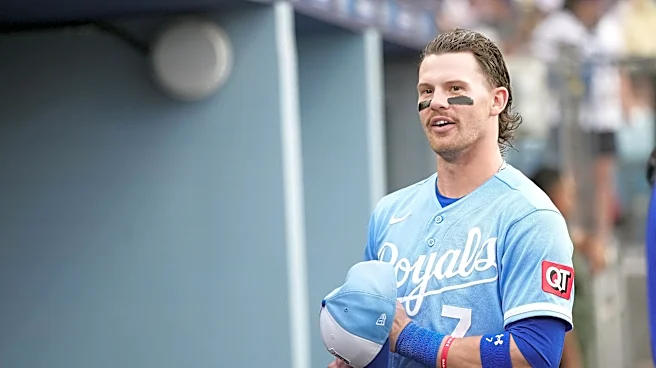
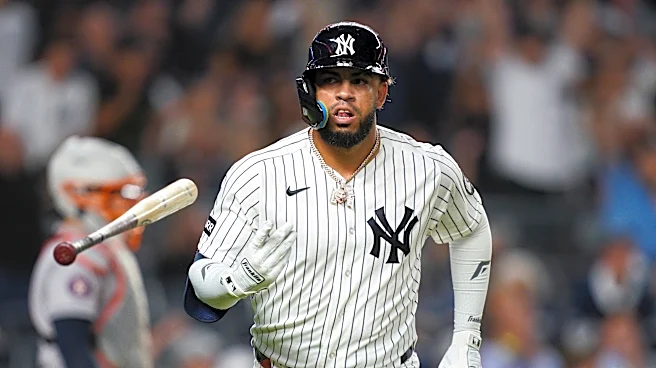
The Kansas City Royals are evaluating Trent Grisham as a potential solution for their center field issues ahead of the 2027 season. Following a 69-93 record in 2026, President of Baseball Operations JJ Picollo identified center field as a key area for improvement.
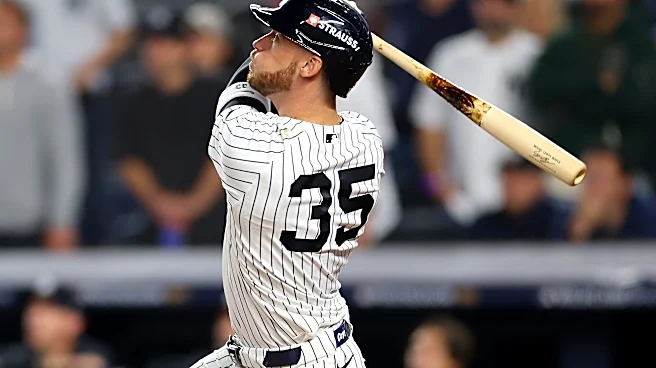
The Royals' center fielders collectively produced a 0.6 fWAR last season, ranking second-to-last in the league. Kyle Isbel, the primary center fielder, had a challenging 2026 season due to a foot injury, limiting him to 100 games and resulting in a .224 batting average and .591 OPS. His performance has declined since 2024, with his wRC+ dropping from 82 to 61 and fWAR from 1.5 to 0.1. Trent Grisham, who spent the last two seasons with the New York Yankees, is projected by some experts to sign with the Royals. While Grisham also experienced a decline in 2026, hitting .211 with a .703 OPS, 18 home runs, and a 0.7 fWAR, his 2025 season was strong, with a .235 average, .812 OPS, 34 home runs, and 3.1 fWAR. The Royals are looking for a player who can provide power and plate discipline, which Grisham has demonstrated in previous seasons.
Why It's Important?
The potential acquisition of Trent Grisham is significant for the Kansas City Royals as they aim to improve their competitiveness in the 2027 MLB season. The team's poor performance in center field in 2026 highlighted a critical gap in their roster, impacting both offensive production and defensive stability. Grisham's offensive profile, particularly his power and plate discipline, aligns with the Royals' strategic goals under new offensive coordinator Connor Dawson, who emphasizes swing decisions and avoiding chases. His ability to hit for power, even if in the 15-20 home run range, would address a major deficiency, as only one other Royals outfielder hit more than six homers last season. However, Grisham's defensive decline, particularly over the last two years with the Yankees, presents a challenge. His negative defensive metrics raise concerns about potentially creating a 'historically bad outfield defense' if paired with other defensively struggling outfielders. This move could either significantly bolster the Royals' lineup and on-base capabilities or exacerbate defensive vulnerabilities, impacting their overall team performance and playoff aspirations.
What's Next?
The Kansas City Royals will need to decide whether to pursue Trent Grisham and, if so, how to integrate him into their outfield given his defensive limitations. Experts project a potential 2-3 year deal for Grisham in the $13-17 million AAV range. If signed, the Royals might consider moving Grisham to left field, where his bat would be a significant upgrade and his defensive liabilities might be less pronounced. This would open up center field for internal options such as John Rave, who showed promise with a 101 wRC+ and 1.0 fWAR in limited plate appearances last season, or a platoon with Tyler Tolbert. A bolder move could involve Carson Roccaforte, a prospect who performed well in Triple-A despite a high strikeout rate. The Royals' decision will hinge on balancing Grisham's offensive potential with his defensive drawbacks and how he fits into their broader strategy for improving the team's overall performance in 2027.
Beyond the Headlines
The Royals' consideration of Trent Grisham reflects a broader trend in MLB where teams must weigh offensive production against defensive metrics, especially for players in premium defensive positions like center field. Grisham's career trajectory, from a Gold Glove winner with the Padres to a defensively struggling outfielder with the Yankees, highlights how injuries and park dimensions can impact a player's defensive value. The challenge for the Royals is not just acquiring talent but optimizing its deployment. Moving Grisham to left field, for instance, acknowledges his offensive strengths while mitigating his defensive weaknesses, a common strategy for teams with aging or defensively declining players. This situation also underscores the importance of player development within an organization, as the Royals are simultaneously evaluating internal prospects like Rave and Roccaforte to fill critical roles. The success of this decision will not only impact the Royals' immediate future but also serve as a case study in strategic roster construction in modern baseball.