


What's Happening?
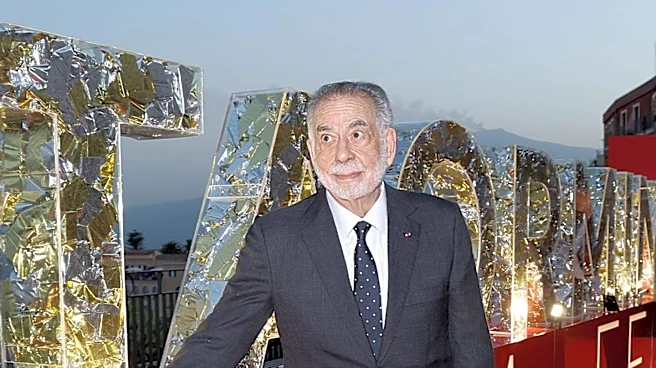
Francis Ford Coppola, the acclaimed filmmaker, recently addressed the role of artificial intelligence (AI) in the film industry during the World Business Forum in Mexico City. Coppola expressed skepticism about AI's ability to create enduring films, emphasizing
the irreplaceable nature of human judgment and creativity. He likened AI to a 'six-year-old' that should assist, not replace, human endeavors. The director also spoke about the financial challenges of his latest film, 'Megalopolis,' which he independently financed after selling a portion of his Francis Ford Coppola Winery for approximately $500 million. Despite the film's reported commercial failure, having only grossed $15 million against a $120 million budget, Coppola announced plans to release a 'completely different' version next year, titled 'Megalopolis Unbound.' He reiterated his artistic philosophy, stating that his films are driven by personal convictions rather than financial gain, a sentiment he has maintained throughout his career, including with past risky investments like 'One from the Heart' (1981).
Why It's Important?
Coppola's comments highlight a significant debate within the U.S. entertainment industry regarding the integration of AI and its potential impact on creative processes and human employment. His stance underscores a growing concern among established artists about maintaining artistic integrity and human oversight in an increasingly technology-driven landscape. The independent financing of 'Megalopolis' through the sale of his winery assets also illustrates the immense financial hurdles faced by visionary filmmakers pursuing non-commercial projects in Hollywood. This trend could lead to more artists seeking alternative funding models, potentially shifting power dynamics away from traditional studios and towards independent production. The commercial performance of 'Megalopolis' and Coppola's subsequent plans for a re-release could influence how future large-scale, artist-driven projects are perceived and funded, potentially encouraging or discouraging similar ventures depending on the ultimate outcome.
What's Next?
Coppola plans to release 'Megalopolis Unbound,' a revised version of his film, next year. This re-release will be a critical test of his artistic vision and could potentially alter the narrative surrounding the film's initial reception. The ongoing discussion about AI in filmmaking, fueled by figures like Coppola, is expected to continue shaping industry policies and creative practices. As AI technology advances, there will likely be increased pressure on studios and filmmakers to define ethical guidelines and best practices for its use, ensuring that human creativity remains central. The financial model employed by Coppola for 'Megalopolis' may also inspire other filmmakers to explore similar independent financing strategies, potentially leading to a diversification of funding sources for ambitious cinematic projects outside the traditional studio system.
Beyond the Headlines
Coppola's career-long commitment to artistic expression over commercial success, exemplified by his willingness to self-finance 'Megalopolis,' reflects a deeper philosophical struggle within the arts: the tension between creative freedom and market demands. His comparison of AI to a 'six-year-old' suggests a need for careful guidance and ethical consideration in its development, particularly in fields that rely heavily on human intuition and emotional depth. This perspective extends beyond filmmaking, touching upon broader societal implications of AI across various creative and professional domains. The enduring appeal of his 'cult' films, despite initial commercial challenges, also speaks to the long-term value of unique artistic visions that may not immediately resonate with mass audiences but gain appreciation over time, challenging the industry's short-term, profit-driven metrics.