







What's Happening?
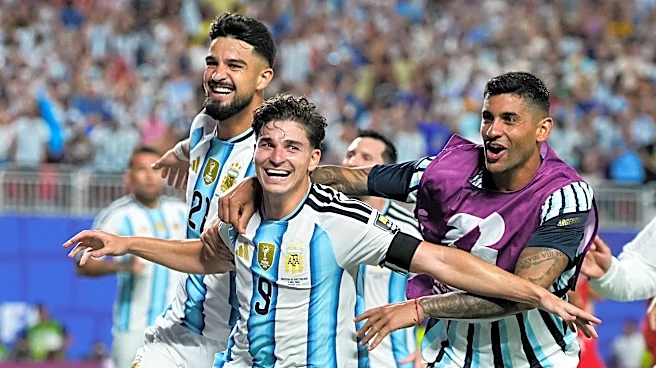
During the 2026 World Cup quarterfinal match between Switzerland and Argentina, Swiss striker Breel Embolo was ejected from the game for simulation, a decision that significantly impacted the match's outcome. Referee Joao Pedro Silva Pinheiro initially
issued a yellow card to Argentina's Leandro Paredes, but after a VAR review, it was determined that Embolo had simulated a foul. This led to Embolo receiving a second yellow card, resulting in his ejection. The decision was controversial, with some commentators and former players arguing it was too harsh. Despite the setback, Argentina went on to win the match 3-1 after extra time, advancing to the semifinals against England.
Why It's Important?
The ejection of Breel Embolo highlights the ongoing efforts by FIFA to curb simulation in soccer, a practice often criticized for undermining the sport's integrity. The decision to use VAR to enforce this rule underscores the technology's growing role in ensuring fair play. For Switzerland, the ejection was a critical blow, reducing their chances of advancing in the tournament. The incident also sparked debate about the consistency and fairness of officiating in high-stakes matches, particularly when decisions can alter the course of a game and a team's World Cup journey.
What's Next?
Argentina will face England in the semifinals, a match that promises to be highly competitive given both teams' performances. For Switzerland, the focus will likely shift to analyzing the match and preparing for future international competitions. The incident may also prompt discussions within FIFA and among national teams about the implementation and impact of VAR, especially concerning simulation and its influence on game outcomes.
Beyond the Headlines
The use of VAR in this context raises questions about the balance between technology and human judgment in sports. While VAR aims to enhance fairness, its application can sometimes lead to contentious outcomes, as seen in this match. The incident may influence future policy decisions regarding the use of technology in officiating, potentially leading to adjustments in how simulation is detected and penalized.