





What's Happening?
Bunker Hill Mining Corp. has commenced a 3,200-foot surface drilling program at its recently acquired Page property in Idaho's Silver Valley, located three miles from its processing facility. This follows the successful completion of a 14,300-foot underground
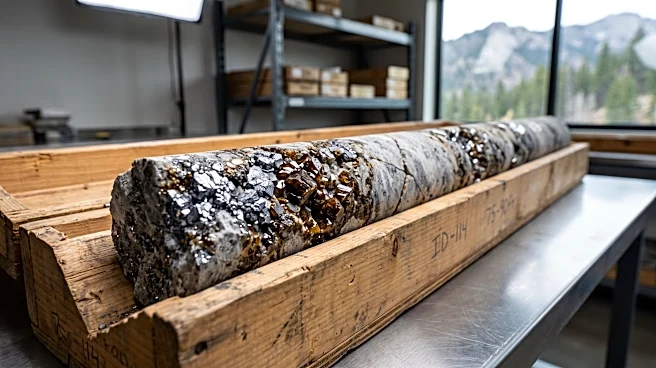
drilling campaign at the Cate-8 Vein. The initial drill hole at the Page property has intersected 15 feet of continuous Galena-Siderite and Sphalerite mineralization at approximately 200 feet depth. This visual assessment suggests a highly prospective area for lead, zinc, and silver. The company's exploration strategy focuses on identifying targets near the surface and existing mine infrastructure to expand mineral resources cost-effectively. Bunker Hill is also progressing towards commercial production at its flagship mine by the end of 2026, having fully commissioned its paste plant and onboarded a fourth mining crew, enabling continuous 1800 tonnes per day (tpd) underground operations.
Why It's Important?
This development is significant for the U.S. mining industry, particularly in the Silver Valley, a historically prolific region for silver, zinc, and lead. The successful intersection of mineralization at the Page property indicates potential for expanding Bunker Hill's mineral resources, which could contribute to domestic supply of critical metals. Increased domestic production of these metals can enhance U.S. supply chain security and reduce reliance on foreign sources, which is a strategic priority. The company's focus on cost-effective exploration and its ramp-up to commercial production at the Bunker Hill Mine signal a revitalization of a storied mining operation. The integration of new resources from the Page property into future mine plans could extend the operational life and economic viability of the entire project, creating jobs and stimulating local economies. Furthermore, the company's commitment to strong environmental and operational standards sets a precedent for responsible resource development.
What's Next?
Bunker Hill Mining will continue its 3,200-foot surface drilling program at the Page property, which is expected to take six weeks to complete. The visual assessments of mineralization will be followed by laboratory assays to determine the grade and extent of the discovery. The data collected from both the Page property and the Cate-8 Vein will be processed to support an updated resource statement, anticipated by the end of Q4 2026. This updated statement will inform the 2027 mine plan, which is expected to include any Cate-8 mineral resources. Concurrently, the company is working towards achieving commercial production at the Bunker Hill Mine by the end of 2026, with targets of at least 65% of 1800 tpd throughput and 70% zinc/lead/silver recovery for 60 days. Studies are also underway for a second portal and processing plant modifications to increase capacity to 2500 tpd.
Beyond the Headlines
The revitalization of the Bunker Hill Mine and the exploration at the Page property highlight a broader trend in the U.S. mining sector: the re-evaluation and re-development of historic mining districts using modern techniques. This approach can unlock significant domestic mineral resources that were previously uneconomical or technically challenging to extract. The use of AI tools for re-interpreting historical data, as mentioned by Bunker Hill, signifies the increasing role of advanced technology in modern mining, aiming for more efficient and targeted exploration. This could lead to a more sustainable and environmentally conscious mining industry. The project's success could also serve as a model for other dormant mining sites across the U.S., contributing to a resurgence in domestic mineral production. However, balancing economic development with environmental stewardship and community engagement will remain crucial for long-term success and public acceptance of such projects.