



What's Happening?
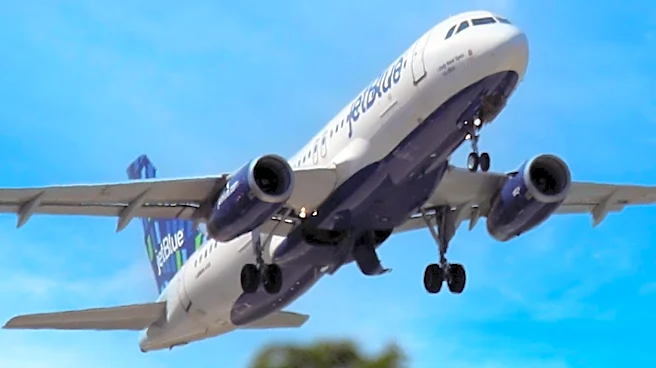
JetBlue CEO Joanna Geraghty has consistently refuted suggestions of the airline facing bankruptcy, despite ongoing financial challenges and persistent rumors of a potential merger with United Airlines. Geraghty has maintained throughout the year that
such claims are unfounded and that JetBlue is committed to an independent financial turnaround. United Airlines Chief Financial Officer Mike Leskinen also publicly addressed the merger speculation, indicating that United is not interested in acquiring JetBlue, citing the latter's problematic financial position as a key reason. Leskinen emphasized that any acquisition assessment would consider the entire enterprise, not just equity value. The discussions around a potential merger gained traction after JetBlue founder David Neeleman suggested a combination would benefit both carriers, strengthening United's presence in key markets and offering JetBlue a solution to its financial difficulties. However, Geraghty has dismissed Neeleman's comments, noting that his perspective is from an outsider who lacks current internal information. JetBlue reported $2.2 billion in liquidity and over $7 billion in assets at the end of September, with a turnaround program aiming for operating profits by 2027.
Why It's Important?
The ongoing speculation surrounding JetBlue's financial health and potential mergers carries significant implications for the U.S. airline industry and its stakeholders. For JetBlue, successfully navigating these rumors and executing its turnaround plan is crucial for maintaining investor confidence, employee morale, and customer loyalty. A merger with a larger carrier like United would drastically alter the competitive landscape, potentially reducing consumer choice and impacting airfares in key markets where JetBlue has a significant presence, such as New York and Boston. United's explicit denial of interest in an acquisition signals a lack of perceived strategic value or an unwillingness to absorb JetBlue's financial liabilities, which could further pressure JetBlue to demonstrate its viability as an independent entity. The situation also highlights the broader challenges faced by independent airlines in an industry susceptible to economic shocks and rising operational costs, particularly fuel prices. The outcome of JetBlue's turnaround efforts will serve as a case study for other mid-sized carriers facing similar pressures.
What's Next?
JetBlue's immediate focus will be on executing its financial turnaround program, which aims to achieve operating profits by 2027. This strategy includes optimizing routes by trimming those with weak demand and expanding in stronger markets, alongside investments in premium products to boost revenue. The airline will likely continue to engage with creditors and investors as part of its normal financial processes, aiming to reassure them of its stability and long-term prospects. Further public statements from CEO Joanna Geraghty are expected to reinforce the company's commitment to an independent recovery and to counter any lingering merger or bankruptcy rumors. The broader airline industry will be watching closely to see if JetBlue can successfully navigate its financial headwinds without resorting to consolidation, especially given the current regulatory environment which has shown some favorability towards consolidation, as noted by United's CFO. The company's performance in the coming quarters, particularly regarding fuel costs and operational efficiency, will be critical in shaping its future trajectory.
Beyond the Headlines
The persistent merger speculation and financial scrutiny surrounding JetBlue underscore a deeper trend within the U.S. airline industry: the increasing difficulty for mid-sized carriers to maintain independence amidst economic volatility and intense competition. This situation raises questions about market consolidation and its long-term effects on consumer choice and innovation. If smaller airlines struggle to survive independently, the industry could become dominated by a few major players, potentially leading to less competitive pricing and fewer service options for travelers. Furthermore, the public dismissal of merger talks by both JetBlue and United highlights the complexities of such transactions, which extend beyond financial valuations to include network integration, regulatory hurdles, and cultural alignment. The narrative also touches upon the influence of company founders, even after their departure, as David Neeleman's comments significantly fueled the merger rumors. This scenario illustrates the ongoing tension between legacy visions and current corporate strategies, particularly when a company faces significant financial pressures.